
[This Week's Topic]
The "Energy-saving" Secrets of the Palletizer
How to tame the "electric beasts" in the warehouse?
This issue's technical director: Gan Lu
In automated vertical storage systems(AS/RS),the gantry stacker crane,as the core handling equipment,directly affects the throughput capacity of the entire storage system.However,the working characteristics of frequent starting and stopping,as well as long periods of standby,have also made the stacker crane a"big energy consumer"in the storage system.
The traditional control mode of stacker cranes often has the problem of"coarse management":regardless of the task's complexity,they operate at high speed with fixed parameters;the braking energy is wasted;and the equipment still"stands by"and consumes electricity during non-operation periods.This not only results in a large amount of ineffective energy consumption,increases the electricity cost for enterprises,but also aggravates the mechanical wear and tear of the equipment.
To address these issues,Shunli Intelligent has launched a brand-new energy-saving control design solution for stacker cranes.Based on the premise of"not reducing operational stability and ensuring operational efficiency",we combine software and hardware to equip the stacker cranes with a"smart brain",achieving precise energy saving and helping enterprises build a green intelligent storage system.
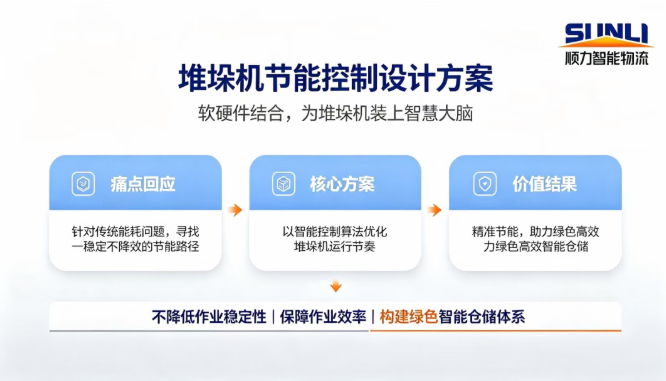
Logic diagram of the energy-saving control scheme for stacker crane
Core Issue: The Energy "Black Hole" of the Traditional Control Mode
The traditional stacker crane control systems mostly adopt fixed parameter strategies, and their energy consumption issues mainly manifest in the following aspects:
Poor matching of operating conditions:Regardless of light loads or short-distance operations,the fixed high-speed parameters used for heavy loads and long-distance operations are still employed,resulting in significant start-stop impacts and high ineffective energy consumption.
Braking energy waste:The regenerated electrical energy generated by the stacker crane during lifting and lowering,as well as during decelerated movement,is traditionally dissipated as heat through braking resistors,resulting in extremely low energy utilization rate.
Idle energy consumption is severe:During non-operation periods,external devices such as drivers and control cabinets still remain powered on,and the power consumption of no-load conditions cannot be ignored.
Job path redundancy:When individual tasks are executed separately,the equipment frequently runs in idle mode,repeatedly resets to zero,and performs invalid repositioning,adding unnecessary operations.
High drive loss:In light-load conditions,the frequency converter adopts fixed excitation,resulting in significant motor iron loss and copper loss,causing energy waste.
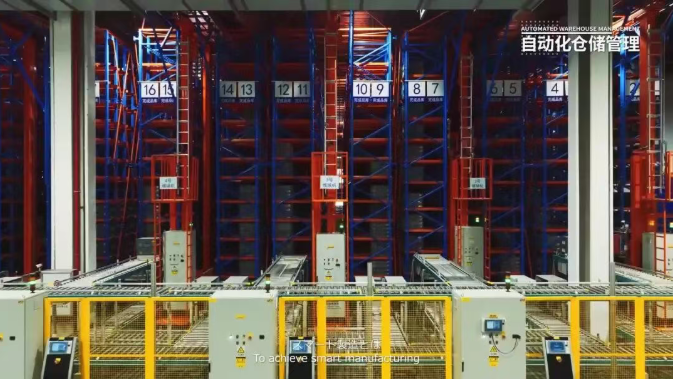
Shunli Intelligent Case: Toyota Syuzen
Core Strategy:Four Energy-saving Technologies,Achieving Accurate Control in All Operating Conditions
In response to the above issues,our energy-saving control solution starts from multiple dimensions such as motion control,energy recovery,and task scheduling,forming a comprehensive strategy.
1.Load Adaptive S-curve Motion Energy-saving Control
This is the core software strategy of this solution.No hardware modification is required.It can be achieved by optimizing the PLC program.The system collects real-time motor current and cargo weighing signals,automatically identifies three working conditions:"empty load,light load,and heavy load",and combines the distance of the task to determine"short-distance,mid-distance,and long-distance"operation modes.
Short-distance operation:Automatically cancel the complete"acceleration-constant speed-deceleration"process,reduce high speed,and reduce kinetic energy loss due to start-stop.
Long-distance operation:Optimize the S-curve,reasonably increase the constant-speed running interval,reduce acceleration and deceleration impacts,and reduce instantaneous power loss.
Heavy-load condition:Appropriately reduce acceleration and braking slopes to avoid high-power impacts,achieve smooth operation to reduce energy consumption.
Empty-load/Light-load condition:Optimize operating parameters within the protection range,find a balance point between energy saving and efficiency.This strategy eliminates unreasonable working conditions such as"short-distance high-speed emergency stop,heavy-load sudden start-stop",compared to fixed-parameter control,it can reduce single-task energy consumption by 10%to 18%,while reducing mechanical impacts and extending equipment lifespan.
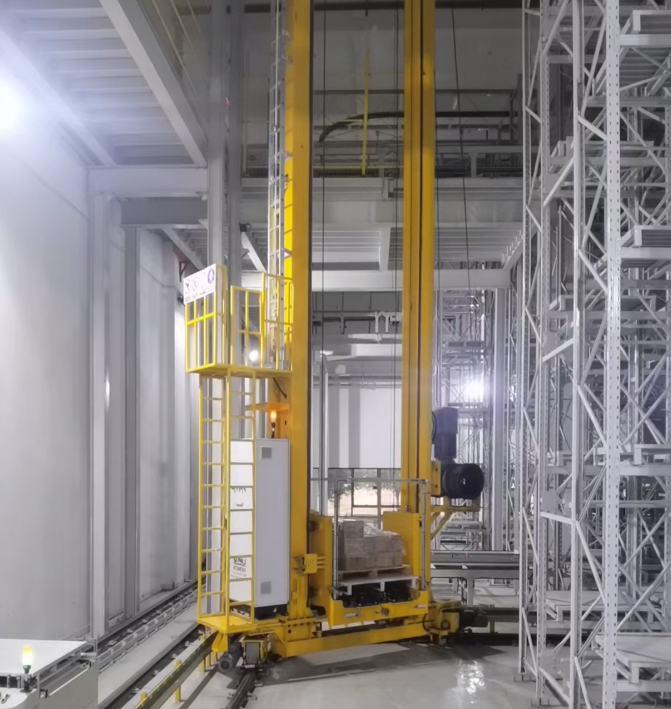
Shunli Intelligent Case: Woldar Technology
2.Regenerative Braking Energy Recovery Control
To address the issue of wasted braking energy in the stacker crane,we have designed an energy feedback control logic,replacing the traditional braking resistor energy consumption mode.
By installing a dedicated energy feedback unit on the variable frequency drive system,when the equipment decelerates or the lifting process descends and generates regenerative electrical energy,causing the bus voltage to exceed the set threshold,the system will automatically activate the unit,stabilize the voltage,and then feed back this part of the energy to the factory power grid,achieving secondary utilization of energy.At the same time,the system is equipped with a complete interlock mechanism to ensure that the equipment operation security is guaranteed in any abnormal situation.This solution can recover 8%to 15%of redundant energy,significantly reducing the overall energy consumption.
3.WCS Optimization Scheduling Energy Saving Control
This is a zero-hardware-cost energy-saving solution,achieving energy savings through the optimization of the upper-level scheduling algorithm at the management level.
Task Merging Control:Change the traditional"one task per operation"mode.The system will automatically aggregate the inbound and outbound storage tasks in the same alleyway and at similar storage positions for batch continuous execution,effectively avoiding repeated start-stop and idle running of the equipment.
Optimal Path Planning:Combining the real-time position of the stacker crane and the target storage position,the intelligent calculation of short combined paths and the planning of optimal operation sequences are carried out to avoid invalid repositioning and detours.
Peak Load Scheduling:Intelligent control of the start-stop sequence of multiple stacker cranes to avoid simultaneous full-load acceleration,reducing the instantaneous peak power of the factory and reducing power grid losses.
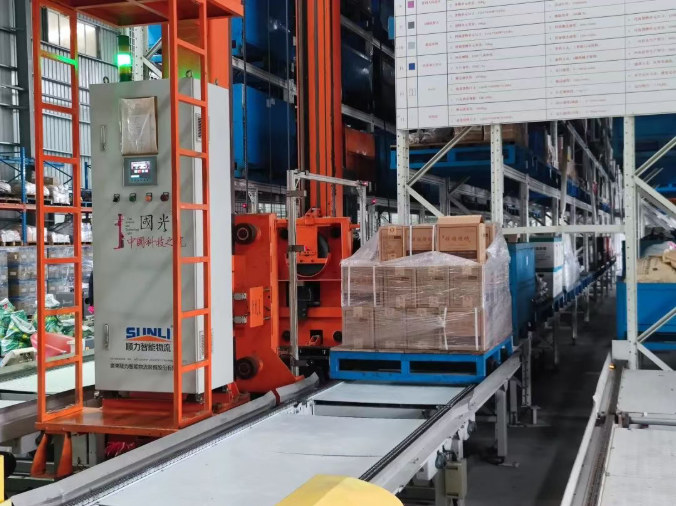
Shunli Intelligent Guangong Palletizing Machine
4.Intelligent Standby and Sleep Mode Control
During non-operational periods,the system will automatically assess the equipment status and enter a low-power"sleep mode".By cutting off the power supply to non-essential peripherals,the idle and standby energy consumption can be reduced by over 30%,completely eliminating the"standby energy consumption"loophole.
Value Presentation:Energy saving,efficiency improvement,cost reduction,achieving three benefits in one
This solution,through the collaborative effect of multiple strategies,brings comprehensive value to enterprises:
Energy consumption benefits:The overall energy consumption can be reduced by 15%to 25%,with significant long-term energy-saving benefits.
Equipment operation and maintenance benefits:The optimized motion curve and reduced start-stop impact can effectively reduce the equipment failure rate by over 30%,reducing spare parts replacement and downtime losses,and extending the equipment service life.
Operational efficiency benefits:Intelligent task scheduling reduces ineffective operation time.While achieving energy savings,it can increase the overall operational efficiency of the warehouse by 5%to 10%,truly realizing a two-way improvement of energy saving and efficiency enhancement.
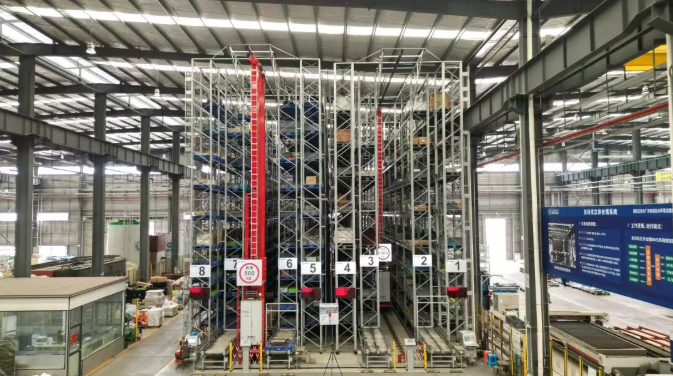
Shunli Intelligent Case: Pengkai Environmental Protection
Shunli Intelligent's energy-saving control solution for stacker cranes is based on the actual pain points of the site, integrating multiple core technologies such as adaptive motion control, energy recovery, and intelligent scheduling. The solution has wide adaptability and can not only meet the energy-saving renovation needs of existing equipment, but also serve as the standard configuration for new intelligent storage warehouses, providing strong technical support for the green and intelligent upgrade of warehouse operations.

Scan to add WeChat