
【Topic of This Issue】
8 Key Pitfalls to Avoid for Dimension Inspection & Weight Inspection
Technical Lead of This Issue:Huang Jierui
In the scheme design of automated AS/RS, two procedures are often briefly mentioned yet require repeated rectification after project go-live: dimension inspection and weight inspection.
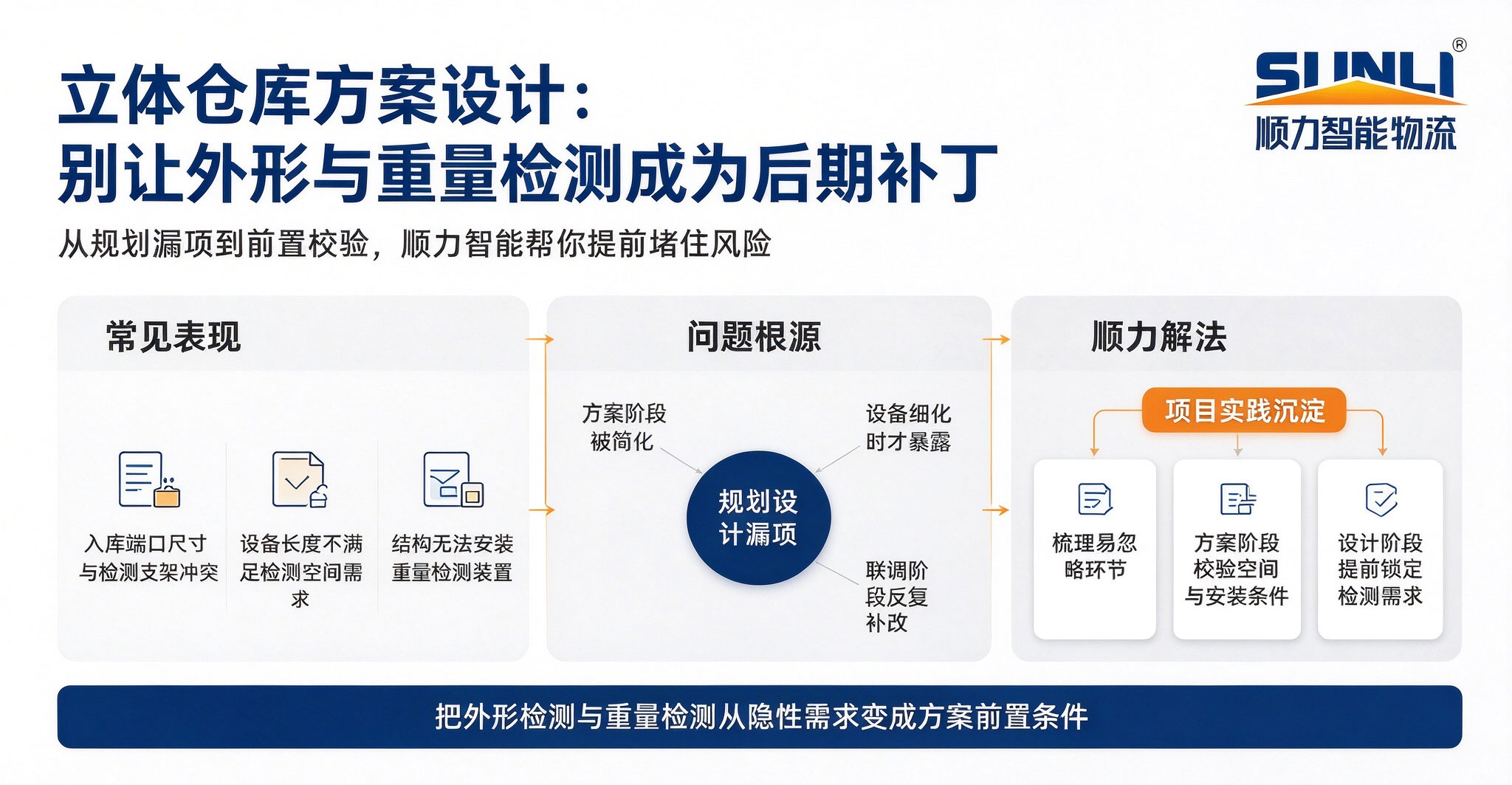
Many projects face this situation: dimension and weight inspection are listed in layout drawings and equipment lists at the proposal stage. Pre-sales teams regard the solution as mature and customers confirm it meets requirements, so both sides reach an agreement smoothly. However, problems gradually emerge during detailed mechanical design and on-site joint commissioning.
Typical issues include conflict between inbound port size and inspection frame, insufficient conveyor length reserved for inspection, and incompatible structure for mounting weighing units. Such defects can only be fixed via repeated adjustments in detailed design. Fundamentally, these problems stem from missing planning items for dimension and weight inspection.
Combining years of project experience, Sunli Intelligent systematically sorts out these risks, clarifies easily overlooked points, and introduces preventive measures that can be implemented at the proposal or design phase.
Dimension Inspection --
More Than Simply Measuring Length, Width & Height
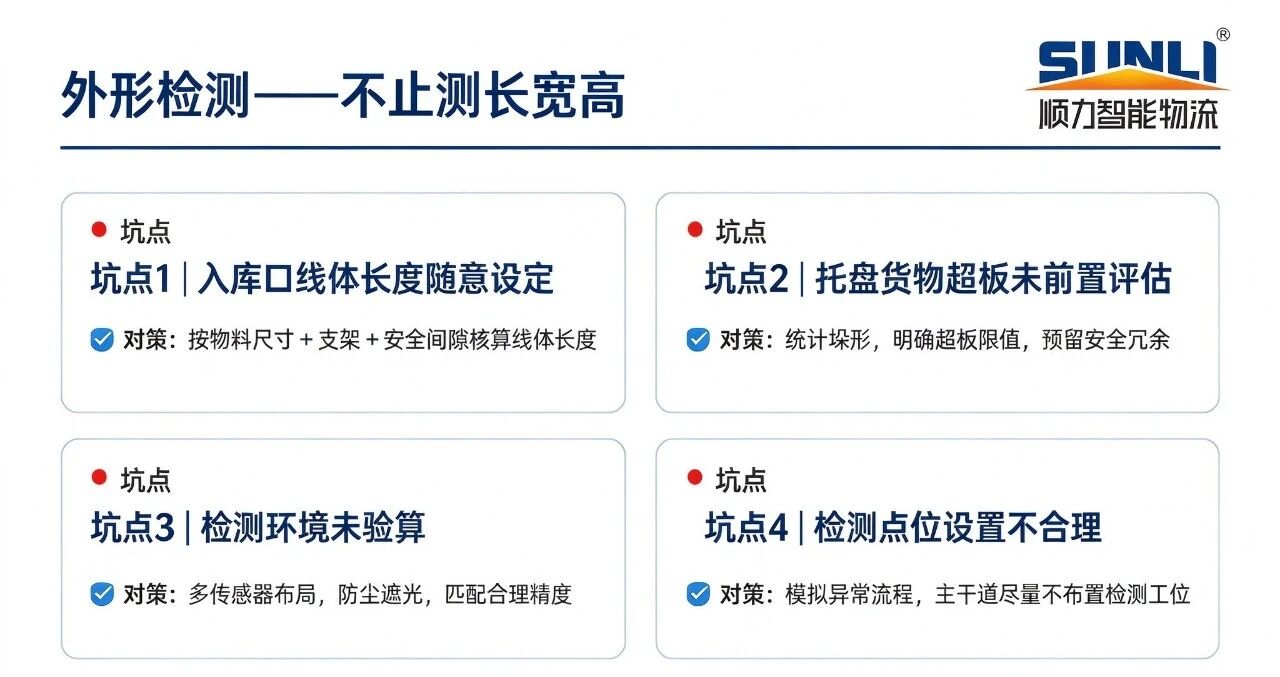
Pitfall 1: Arbitrary definition of inbound conveyor length
Restricted by site space, storage capacity, dimension reservation or reuse of existing modules, inbound/outbound conveyors are often designed too short. Designers ignore the overall size of palletized loads, mounting space for inspection frames and safety clearances. As a result, compromises have to be made on inspection functions, mechanical structure, photoelectric sensing, workflow logic and control programs during detailed design.
Therefore, before defining conveyor length at inbound/outbound ports, full communication with the client is required to obtain dimension characteristics of handling & storage units (pallet loads). Based on these data, the mounting space of the inspection frame is confirmed. Safe loading clearance is reserved according to product features, and the final conveyor length is determined comprehensively.
Inbound Conveyor Length = Length of Palletized Load in Conveying Direction + Stacking Deviation Tolerance + Safety Clearance between Load and Frame + Frame Mounting Dimension + Stop Safety Distance for End Photoelectric Sensor
Pitfall 2: Lack of proper guidance for overhang pallets
To control costs and maximize container utilization, enterprises adopt various stacking patterns. Load overhang (goods extending beyond pallets or carriers) and over-height stacking are common phenomena. If the dimensions and stacking profile of goods are not fully studied and reasonable suggestions are not provided in advance, risks will be carried into detailed design and on-site commissioning, leading to long cycles of revision and local compromise.
Sunli Intelligent recommends the following measures:
① Illustrate the impacts and potential hazards of overhang to the client with reference cases for in-depth communication. Main risks brought by overhang:
Frequent alarms from dimension inspection systems and mechanical equipment, reducing operational efficiency;
Over-height overhang loads introduce safety risks during high-level handling;
Scrapping between overhang goods and online equipment may damage cargo in mild cases, or break equipment. Falling goods can trigger severe safety accidents.
② Take photos, measure, count and analyze packaging styles during preliminary survey, define allowable overhang range, and communicate uncontrollable overhang cases with the client to avoid technical compromise or negligence;
③ If overhang cannot be avoided, mechanical and electrical teams shall reserve sufficient safety margin in equipment dimensions, formulate countermeasures and carry out technical verification after comprehensive evaluation.
Pitfall 3: No verification of measurement environment
Laser and vision inspection deliver high precision in lab tests, yet stability deteriorates on site. Reflective stainless steel bins, stretch film, oil stains and dust may interfere detection. Tilted goods, conveyor deviation and protruding components also create blind zones.
Countermeasures: Deploy multi-sensors from multiple angles to eliminate blind zones; install hoods and self-cleaning units for cameras; reserve straight conveyor sections before and after the inspection station so measurement starts only after goods are stabilized. Besides, resolution and accuracy shall match practical requirements instead of pursuing excessive specifications blindly.
Pitfall 4: Unreasonable inspection position against workflow
Influenced by various factors, the proposal may ignore the layout logic of dimension inspection stations, which causes inspection failures during operation. If risks are not identified in detailed design and equipment is manufactured according to the original scheme, detection faults, mechanical interference or collision between goods and machines may occur in on-site testing.
Therefore, abnormal working conditions shall be simulated at the proposal stage to define the material flow and handling plan for non-conforming loads. If space permits, dimension inspection stations should not be placed on the main conveyor trunk, otherwise abnormalities will lead to large-area congestion.
Meanwhile, evaluate pallet dimensions of client goods. If goods exceed reserved space, adjust the frame size, or design reverse workflow and dedicated rejection ports. Pallets with minor dimension deviation can be forwarded to the preset rejection station.
Weight Inspection -- It Is Not Enough Just to Have the Function Configured
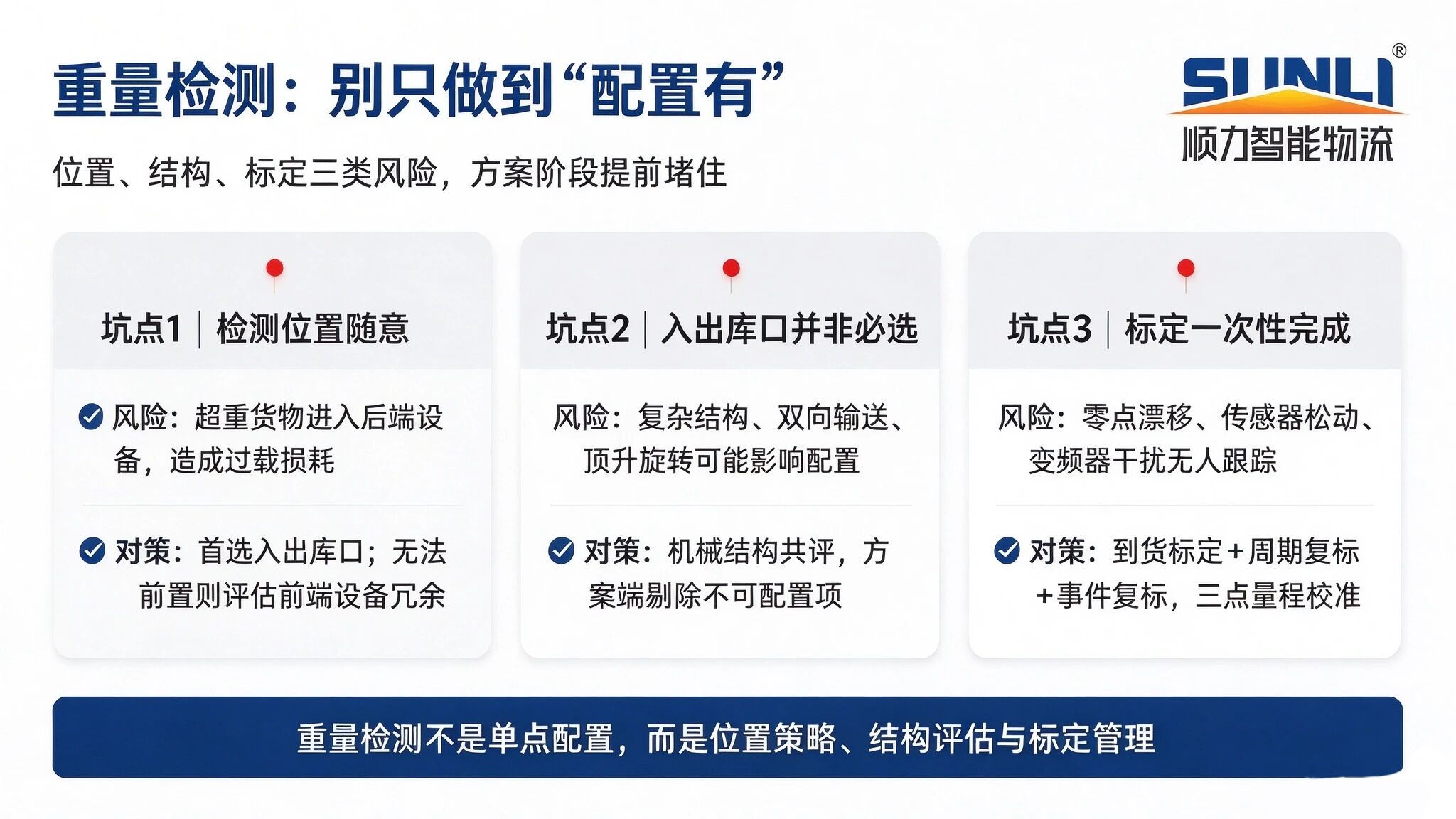
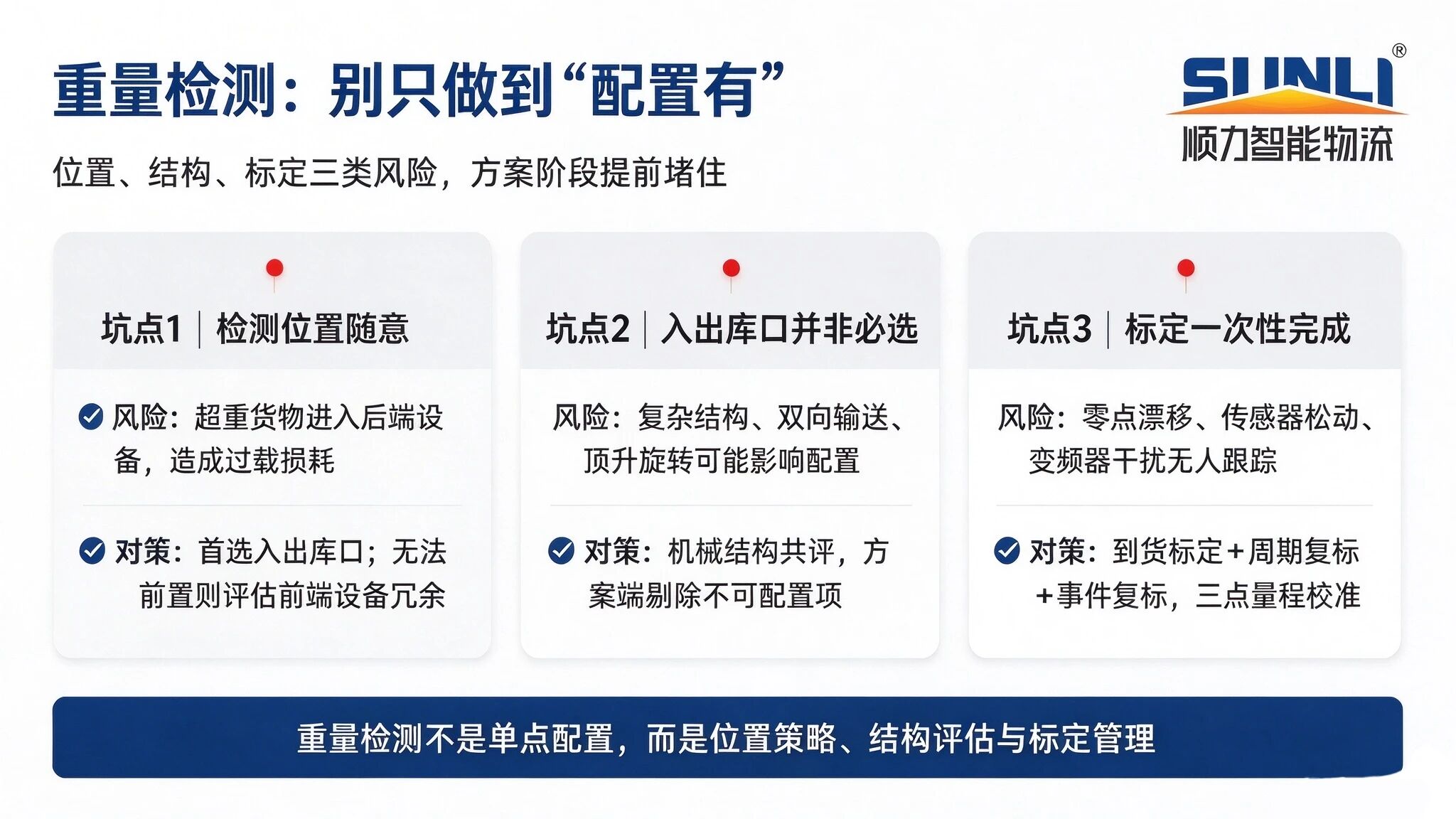
Pitfall 1: Random arrangement of weight inspection stations
Randomly installing weighing units on conveyors is a typical mindset of “just having the function”. If the weighing station is placed too far downstream while overload occurs, upstream conveyors will run under or near overload condition. Frequent overloads will cause irreversible damage to equipment.
Weight inspection stations are preferably arranged at inbound/outbound ports. Weight judgment is completed at the earliest stage to minimize subsequent invalid actions. Once abnormal weight is detected, the system triggers alarms and alerts operators for intervention.
If layout and structural constraints prevent installation at the preferred position, communicate with the client to confirm the maximum possible overload range, and select upstream equipment with adequate design margin after comprehensive assessment.
Pitfall 2: Inbound/outbound ports are preferred positions rather than mandatory positions
Inbound and outbound ports are the preferred locations for weight inspection, but not mandatory. When inbound/outbound conveyors feature complex structures and tight dimensional constraints, weighing modules may not be installable.
If the inbound conveyor has complicated functions such as bidirectional conveying, lifting & rotating mechanisms, and its gravity relies on ground-connected structures, mechanical designers shall jointly evaluate and provide suggestions, strategies or alternative structural selections to eliminate such risks at the proposal stage.
Pitfall 3: One-time calibration without technical handover to the client
If calibration is only done once during installation without handover and regular re-calibration reminders, zero drift, loose sensors and inverter interference will remain unattended. Long-term operation beyond rated load may raise equipment damage risks.
We recommend a 3-level calibration system: acceptance calibration, periodic re-calibration (daily/weekly/monthly), event-triggered re-calibration (after vibration, relocation, sensor replacement or abnormal drift). Calibration shall adopt certified weights at 20%, 50% and 80% of full scale.
Conclusion
On technical descriptions or proposal PPTs, dimension and weight inspection are often simply noted as “equipped with dimension & weight inspection”. In actual projects, however, they act as gatekeepers ensuring reliable automation operation and form the first line of defense after go-live. Most pitfalls above are not technically infeasible, but overlooked at the proposal stage. Sunli Intelligent recommends identifying and closing all hidden risks at the drawing phase. Extra site surveys and calibration reviews reduce on-site rework and unexpected downtime.

Scan to add WeChat