
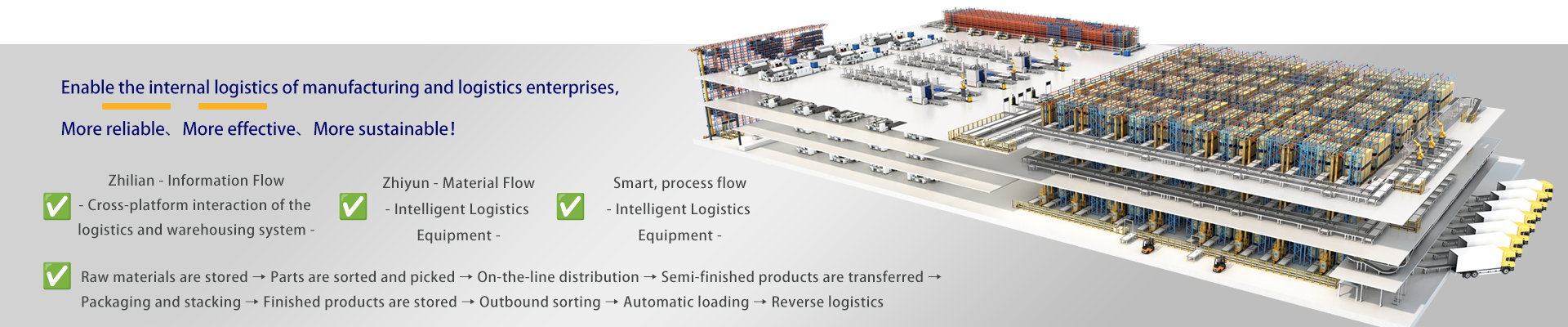
On the basis of traditional automated high-bay warehouses, intelligent AS/RS integrates sensor recognition, data interaction, scheduling algorithms and information systems to realize automatic access of warehouse materials, status perception, intelligent task allocation and data traceability analysis. It is widely used in equipment manufacturing, new energy, pharmaceutical, food and other industries, and compatible with standardized storage units such as pallets and bins.
The complete system consists of high-rise racks, automated handling equipment, conveying connection units, sensing and recognition modules and software platforms. As the load-bearing main body, high-rise racks are built with modular steel structures. Storage locations are divided according to material specifications, workshop floor height and ground load. Different rack types including single-deep, double-deep and shuttle racks can be selected to match different storage densities and access speeds.
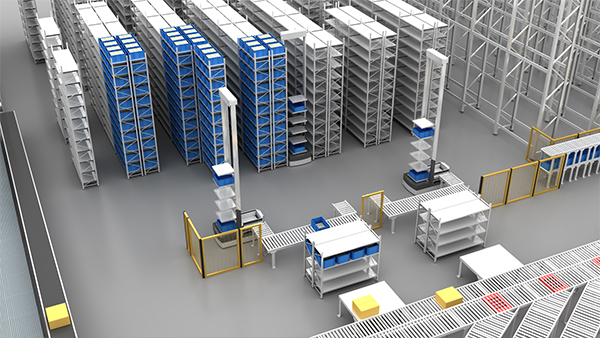
Stacker crane is the core execution equipment of aisle-type intelligent AS/RS. It travels, lifts and stretches the fork within the rack rail to complete cargo access. The shuttle vehicle solution combined with hoists for layer transfer is suitable for high-density storage scenarios. Conveying units include roller conveyors, transfer lifters, AGV/RGV and depalletizing & palletizing mechanisms, which connect the storage area with receiving inspection, picking and outbound stations to open up the material circulation channel.
The sensing and recognition module provides on-site data support for the system, including barcode readers, RFID readers & writers, laser ranging sensors, limit switches and vision acquisition devices. During material circulation, coding, batch and position information are continuously collected. Equipment feeds back operating parameters such as speed, position and load to support system judgment and scheduling. Temperature, humidity and smoke detectors are added in some projects to monitor the warehouse environment synchronously.
The software system adopts a multi-layer architecture. The upper layer connects with business systems such as ERP and MES to receive production plans, purchase and sales orders. The middle layer is the WMS (Warehouse Management System), which manages inventory accounts, location assignment, batch control and inventory counting. The lower layer WCS (Warehouse Control System) receives tasks from WMS, schedules stacker cranes, shuttles and conveyor lines, balances task sequence of multiple devices and reduces path conflicts.
Compared with conventional AS/RS, intelligent AS/RS supports data-driven task optimization. Combining order urgency, material turnover frequency and real-time equipment load, the system dynamically adjusts storage locations and task sequences. Fast-turnover materials are assigned to locations close to access ports to shorten equipment travel distance. Multi-order joint scheduling reduces empty running of equipment and improves operation efficiency.
For inbound process, incoming goods are inspected and verified, labeled and recorded into the system. WMS automatically allocates storage locations, and WCS schedules conveying and access equipment to complete putaway. Inventory data is updated automatically after putaway. For outbound picking, the system parses order requirements and sends picking instructions. Materials are transported to picking stations, rechecked after picking and then shipped. All information is automatically retained at each step to form a complete traceability chain.
Warehouse data is continuously aggregated and analyzed to generate statistical reports covering inventory turnover, location utilization and equipment OEE. Managers adjust stocking strategies and inventory levels based on reports, coordinate material supply with production rhythm, and reduce overstock or material shortage.
Protection functions are embedded with intelligent control logic. Aisle areas are equipped with physical fences and photoelectric protection, triggering interlock shutdown when personnel intrude. Stacker cranes and shuttles are fitted with anti-collision, limit and overspeed monitoring. The system has built-in fault early warning. It collects motor current, temperature and vibration data and pushes alerts for abnormal trends to facilitate predictive maintenance.
A digital operation and maintenance mechanism is established after commissioning. Equipment logs, alarm records and maintenance plans are managed uniformly on the platform. Regular inspections are carried out on rack connectors, rails, forks and sensors to calibrate positioning accuracy and remove dust on sensing components for stable signal acquisition. Data of networks and servers are backed up periodically to mitigate risks from communication interruption and data loss.
Intelligent AS/RS is more than automated material access equipment; it is a warehouse system linking physical goods, equipment and data. With information interconnection and intelligent scheduling, it streamlines inbound and outbound material flow, standardizes inventory management and meets the warehousing demands of continuous production for enterprises.

Scan to add WeChat