
【Topic of This Issue】Why Do Warehouse Waves Keep Swinging Between Idle Waiting and Rush‑Hour Panic? You May Need an Intelligent Order Pool!
Technical Contributor: Xiao Yingwu
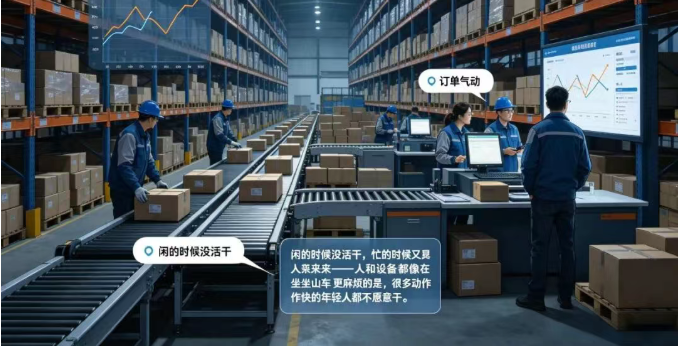
Last month, I visited an e‑commerce warehouse in Guangzhou. Mr. Zhou, the warehouse operations supervisor, held a thick stack of wave picking documents and told me: “From 9 to 10 a.m., pickers sit idle waiting for waves. At 10 a.m., orders flood in all at once, and everyone works at breakneck speed. These wave orders also create inefficient picking routes. Staff walk over 30,000 steps a day with plenty of unnecessary travel.”
I asked: “Aren’t your wave rules pre‑configured?”
He replied: “We set waves to trigger every half‑hour. But orders do not arrive neatly in half‑hour cycles. Sometimes only a dozen orders sit in the pool, yet we still trigger a wave. At other times hundreds of orders accumulate, and we must wait for the timer. Our manpower and equipment keep riding a roller‑coaster of idle time and overwork.
Worse still, many young, agile workers do not want to stay on this job!”
This scenario will look familiar to many warehouse managers; it is a common pain point for most WMS‑driven wave‑picking operations. So how can we resolve it?
I. The Root Cause Lies Not in Wave Execution, but in the Upstream Order Pool
Most traditional WMS order pools act merely as passive reservoirs. Orders flow into the pool, and once preset wave‑trigger conditions (such as every 30 minutes or accumulating 50 orders) are met, all pooled orders are dumped out to generate one wave. The system pays no attention to order characteristics, priority sequencing, consolidation of similar orders, or route optimization within each wave; it only executes mechanically. Consequently, every wave consists of randomly assembled orders, producing back‑and‑forth picking paths, while labor and equipment cycle repeatedly between waiting and frantic rush work.
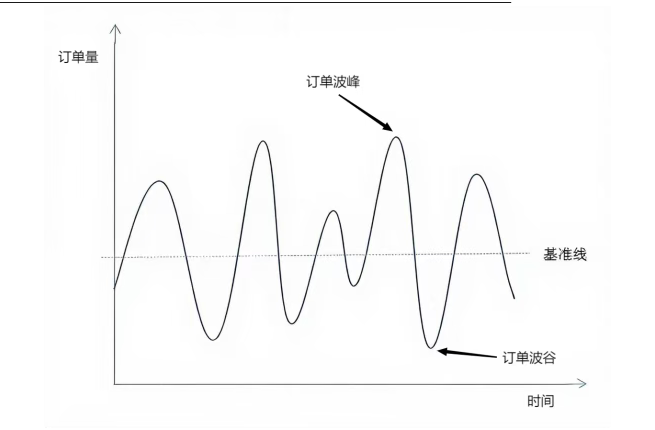
Fig: Order Wave Trend Chart
To solve Mr. Zhou’s challenges, we deployed our order‑pool optimization solution in his warehouse. While keeping the existing wave framework unchanged, intelligent order‑pool optimization smooths warehouse operations from a roller‑coaster pattern to steady, consistent throughput.
Two weeks later, Mr. Zhou reported: “Wave fluctuations have improved dramatically. The extreme busy‑idle swings caused by poor wave scheduling have largely disappeared. This WMS order‑pool optimization has delivered real value.”
How can upgrading only the order pool, without replacing the wave framework, achieve such significant improvement?
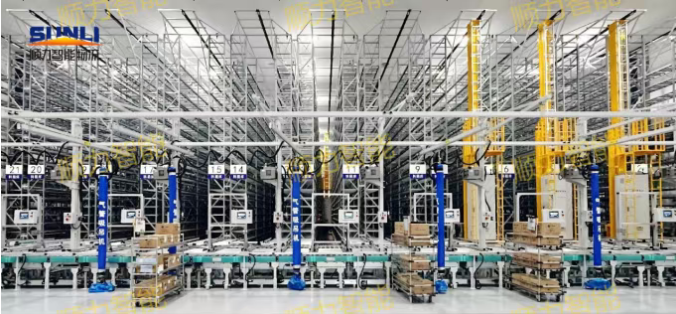
Fig: Jabil Electronics Miniload Bin‑picking Solution
II. Four Core Measures for Improvement
1. Pre‑order Classification — Fine‑grained Tagging for Every Order
Traditional systems only record which zone an order belongs to upon pool entry. Sunly WMS order‑pool optimization immediately extracts each order’s “location fingerprint” and assigns precise, detailed tags the moment orders enter the pool.
In short, the system automatically computes key coordinates on arrival: which aisles are involved, rack levels, and the geometric center of the picking route. It pre‑calculates the travel footprint for every individual order.
2. Intelligent Wave Consolidation — Group Orders with Similar Operating Patterns
With location fingerprints available, Sunly WMS applies an enhanced clustering algorithm to group highly‑similar orders into pre‑wave sets. Similarity is evaluated across three major dimensions:
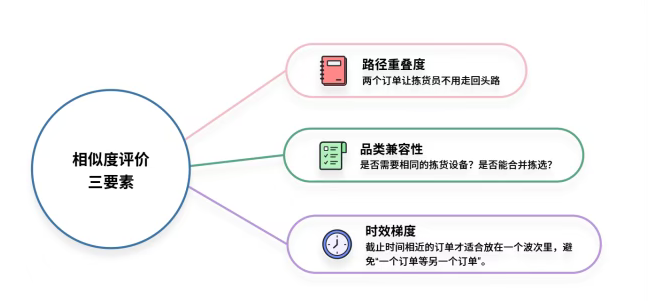
Fig: Three Similarity Evaluation Factors of Sunly WMS Clustering Algorithm
Take three orders within Aisle 1 as an example: Order A (Columns 1‑5, ambient temperature, cut‑off 16:00); Order B (Columns 3‑8, cold‑storage, cut‑off 16:30); Order C (Columns 2‑6, ambient temperature, cut‑off 16:05). A traditional order pool would combine all three into one wave. The intelligent order‑pool logic recognizes that A and C share ambient‑temperature requirements with only 5‑minute cut‑off offset and can be fulfilled in one trip. B requires cold‑chain equipment and separate access, so it does not meet high‑similarity criteria. A and C form one wave, while B runs as an independent cold‑chain wave.
This approach identifies truly “frequency‑aligned orders” to assemble optimized waves.
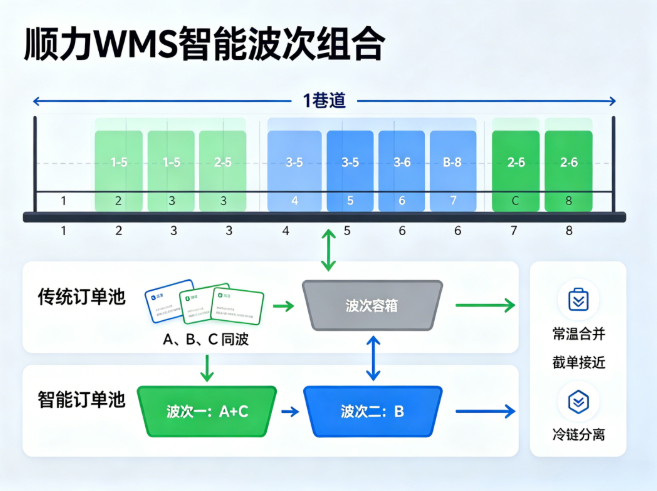
Fig: Example of Intelligent Wave Grouping in Sunly WMS
3. Dynamic Priority — Dedicated Fast‑lane for Urgent Orders
How to handle rush orders? Traditional wave systems either force urgent orders to wait for the next cycle or jam them into existing waves and disrupt picking rhythm.
Sunly WMS implements a fast‑lane mechanism. Within 0.2 seconds after an urgent order arrives, the system checks route compatibility with currently‑executing waves. If routes align, the urgent order merges directly. If not, a new pre‑wave group is built around this urgent order for the upcoming release cycle, instead of crudely inserting it into an existing wave.
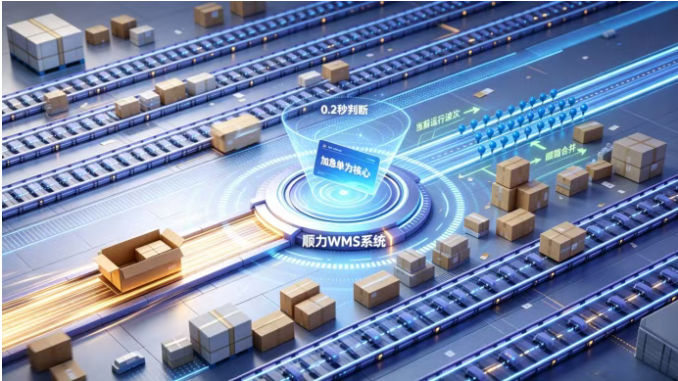
Fig: Urgent‑order Handling Workflow in Sunly WMS
Mr. Zhou later commented: “Urgent‑order calls used to give me headaches and required lots of manual intervention. Now the system handles them automatically, and urgent‑order throughput has improved significantly.”
4. Smoothed Wave Rhythm — From Roller‑coaster to Stable High‑speed Operation
To eliminate the boom‑and‑bust pattern of traditional waves, the order pool leverages forecasting for proactive scheduling. Based on historical data and upstream advance notifications, the system predicts order volume trends for the next 1‑2 hours and actively adjusts wave release cadence.
When an order surge is anticipated, non‑urgent orders are released in advance to free pool capacity for subsequent priority orders, achieving peak‑shaving and valley‑filling effects.
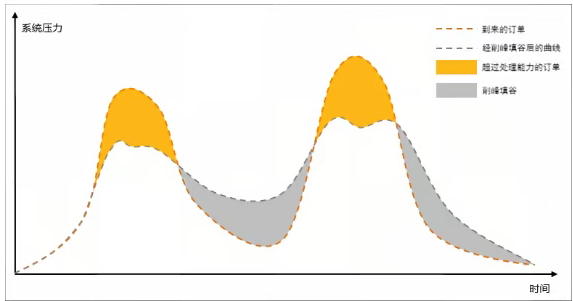
Fig: Peak‑shaving & Valley‑filling Strategy of Sunly WMS
During low‑volume troughs, wave triggering is deferred. Small‑volume orders are accumulated until reaching a reasonable batch size before release, avoiding frequent equipment start‑stop cycles and idle labor triggered by tiny batches.
III. Optimize Your Order Pool via Three Key Parameters
If you cannot replace your system entirely but want to improve within your existing wave framework, start with these three parameters:
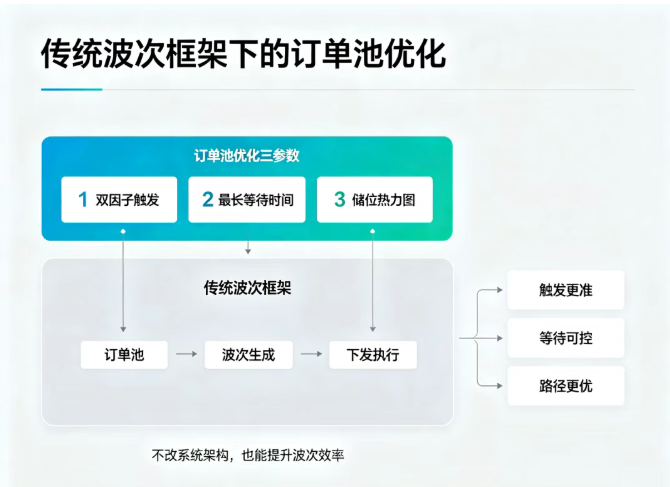
Fig: Key Tuning Points Without System‑architecture Overhaul
1. Adopt Dual‑factor Wave Triggering
Avoid relying purely on time or purely on order count. Enable combined “time + quantity” triggers, e.g. trigger a wave only when “20 minutes have elapsed AND at least 30 orders are accumulated”. This delivers partial peak‑shaving benefits. Sunly WMS supports multi‑factor logical combinations for greater flexibility than single‑factor rules.
2. Set Maximum Order Waiting Duration
Define a maximum residence time for orders inside the pool. Once an order hits this waiting‑time threshold, it is forcibly pulled out for wave generation regardless of other trigger conditions. This safety guard prevents certain orders from being perpetually skipped. Sunly WMS automatically assigns differentiated waiting‑time limits for orders with different service‑level requirements.
3. Keep Location Heat‑maps Updated Timely
Traditional WMS wave grouping references static location assignment tables. If bin locations change frequently while grouping logic still uses outdated tables, grouping accuracy degrades. Refresh location heat‑maps for your order pool to reflect real‑world conditions. Sunly WMS computes location fingerprints on‑the‑fly, natively resolving this pain point.
IV. Optimize the Order Pool Without Large‑scale Overhaul
We fully understand warehouses cannot shut down completely to deploy brand‑new systems overnight. Process inertia, staff habits and upstream‑downstream interfaces dictate incremental change.
That is exactly why Sunly WMS Intelligent Order Pool is built for low‑impact upgrades. It reuses your existing wave framework; only order‑pool intelligence is enhanced, yet tangible efficiency gains emerge. Built on top of your current wave logic, it optimizes order‑pool processing so that every released wave already carries well‑organized picking groups.
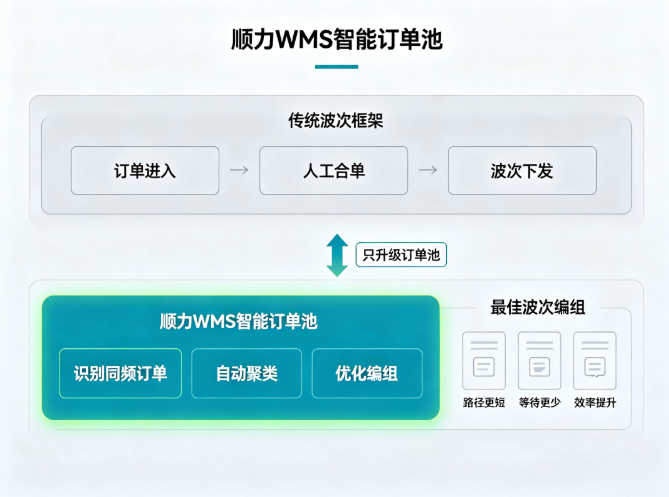
Fig: Principle of “Low‑invasion Upgrade”
After tuning order‑pool strategies and algorithms for typical e‑commerce warehouses, pickers reduce redundant travel and overtime work, while picking efficiency increases by more than three times. Operations supervisors like Mr. Zhou are freed from constant fire‑fighting, gaining bandwidth to focus on cost reduction and quality improvement. Higher warehouse picking performance does not always require massive reconstruction. Optimization can happen while orders are still queuing, with calculations completed in advance by your system. Is your order‑pool ready to think intelligently?

Scan to add WeChat