
【Topic of This Issue】
Does Your Facility Meet EHS Acceptance & Compliance Requirements for Foreign‑owned Factories?
Learn about Sunly Intelligent’s PL d‑level Safety Protection System!
Technical Contributors: Mo Xiancheng, Gan Lu
With years of experience delivering intelligent warehousing projects, I have noticed that core customer acceptance criteria have quietly shifted. I gained deep insight during the delivery of Sunly Intelligent’s four‑way dense automated warehouse for Jabil Electronics in Guangzhou. The customer’s EHS manager took charge of safety‑related acceptance, checking every protection point against his tablet:
“What is the protection logic against electric shock for the four‑way shuttle charger?”
“What safeguards are in place to prevent falls during hoist maintenance?”
“How many milliseconds does it take for an RGV to stop if personnel enter its aisle?”
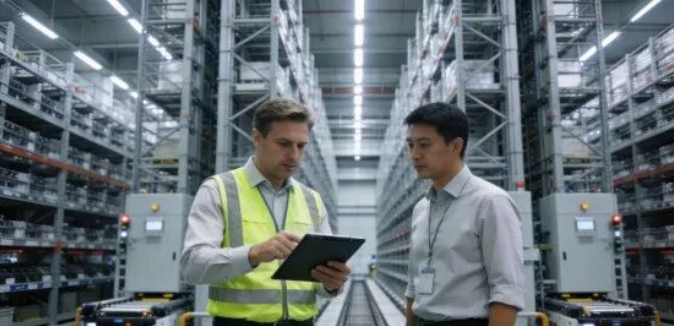
From these questions, I realized customers are no longer satisfied with merely having safety hardware installed. What truly matters is whether each piece of equipment delivers robust safety performance. They are not assessing individual components, but the performance level of safety‑related circuits across every device within the warehouse.
He then explained: “As a foreign‑invested enterprise, we follow EU Machinery Directives and FM Global’s HPR risk‑control standards, which mandate internationally‑certified safety performance levels. Therefore, key safety functions of all moving equipment in this four‑way warehouse project must achieve PL d performance level for project acceptance and FM Global insurance policy issuance. A previous supplier only implemented superficial safety measures, causing lengthy delays.”
Many suppliers would struggle with such requirements, yet we have refined our solutions repeatedly. Consequently, we responded to these requirements with full confidence.
I. What Exactly is Equipment PL Performance Level?
Many industry peers and even customers lack a clear understanding of PL level. Simply put, it is a graded rating for equipment safety‑related control systems defined under international and national standards. Higher ratings mean more reliable safety mechanisms that are less prone to failure under fault or hazardous conditions, minimizing personal‑injury risks. Lower ratings correspond to weaker protective performance.
Covering mechanical, mechatronic and electrical aspects, the PL system guides safety design and mitigation measures through risk assessment and classification, helping guarantee operator safety and equipment reliability during selection, installation and operation. Performance levels range from PL a to PL e. PL d and PL e represent mainstream high‑safety grades for automated equipment.
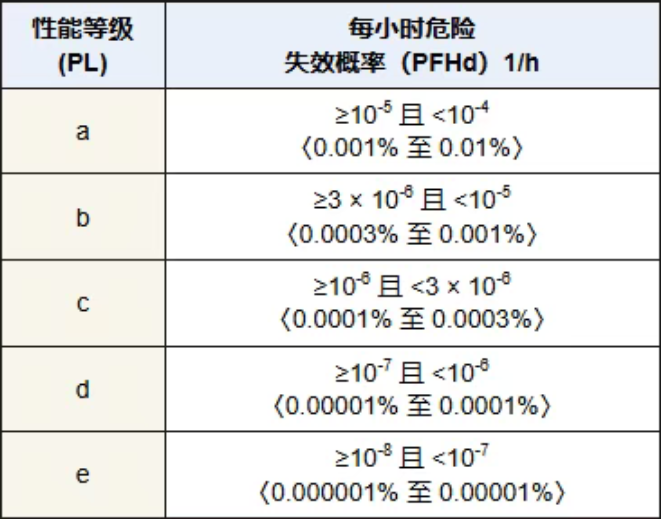
Fig: Performance Level Classification Diagram
II. Why Evaluate Safety Performance Levels for Equipment?
Some may question why so much effort is spent on safety‑level evaluation. In my view, four core reasons underpin its importance.
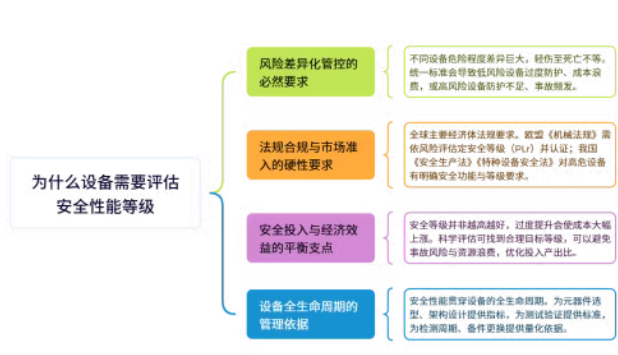
Fig: Four Elements of Stable‑Performance Assessment
III. Common Safety Shortcomings Found in Many Warehouses
Having visited numerous warehousing sites, I have witnessed many worrying “so‑called safety measures”. Some stacker cranes use ordinary limit switches as safety door locks, allowing machines to keep running even with doors open. Some four‑way‑shuttle chargers expose live terminals without warning signs. Operators work atop roller conveyors with only steel structures underneath, creating fall‑through hazards. Some RGV aisles allow mixed personnel‑vehicle traffic, relying entirely on verbal warnings. Certain hoists use simple wooden boxes underneath as makeshift fall protection for maintenance staff. These sites are riddled with latent safety risks.
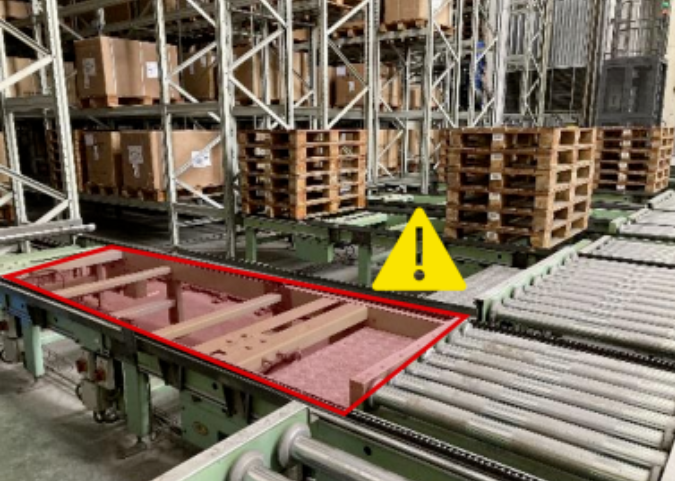
Fig: Diagram of Non‑standard On‑site Practices
These superficial protective measures fail to deliver safe operation and maintenance. This cannot be blamed solely on front‑line operators. Many system integrators neglect risk differentiation for different equipment, and warehouse managers underestimate the wide variance in hazard levels across devices.
A conveyor runs at low speed with light loads; malfunctions may only cause minor abrasions. By contrast, a fully‑loaded stacker crane travels dozens of meters above ground; loss of control can trigger catastrophic accidents. An RGV moving through mixed‑traffic zones may inflict severe bodily injury upon collision.
Regrettably, many warehouse designs apply one‑size‑fits‑all safety standards without differentiating equipment‑specific risks. This leads to sub‑optimal outcomes: over‑protection for low‑risk equipment wastes capital and resources, while high‑risk devices remain under‑protected with severe safety consequences.
IV. Sunly Intelligent’s Approach
Within Sunly’s R&D framework, safety protection is not an afterthought add‑on. Instead, safety is a core consideration throughout the full lifecycle: system design, component selection, testing and project delivery. This philosophy stems from deep industry risk awareness and dual drivers of market compliance and customer value.
1. Differentiated Risk‑based Safety Adaptation for Application Scenarios
Logistics equipment covers a broad risk spectrum, ranging from minor injuries to permanent disability or fatalities. Sunly conducts comprehensive risk assessment for each solution, setting target safety performance levels and corresponding countermeasures according to injury severity, personnel‑exposure frequency and hazard‑avoidance difficulty.
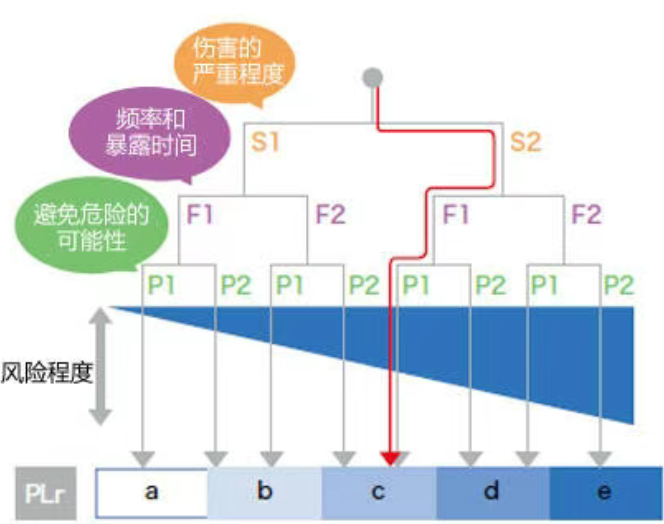
Fig: Risk Assessment Schematic
2. Full‑scope Design Satisfies Global Market Compliance Requirements
Foreign‑owned customers keep raising EHS‑management requirements, and safety‑performance levels have become hard project‑acceptance thresholds. EU Machinery Directives and FM Global HPR risk‑control standards both require internationally‑recognized safety‑level certification for equipment.
Guided by stringent FM Global criteria, Sunly’s four‑way‑shuttle warehouse project for Jabil achieved PL d level verified by third‑party on‑site inspection, serving as a reference case for intelligent warehouses complying with international safety standards end‑to‑end.
3. Balancing Safety Investment and Long‑term Operational Value
Higher PL levels do not mean unlimited cost escalation. Instead, we pursue optimal balance between safety reliability and economic viability. Leveraging standardized rating frameworks, Sunly delivers scenario‑tailored safety schemes, avoiding waste from over‑engineering while eliminating accident risks caused by insufficient protection.
For large‑scale manufacturers and foreign‑owned enterprises focusing on EHS systems, logistics equipment with defined safety‑performance levels can be directly integrated into corporate safety management frameworks, supplying traceable, verifiable technical evidence for safety audits, risk evaluations and compliance inspections.
V. What Sunly Intelligent Can Deliver for You
Within projects, PL d safety performance directly governs operational safety, especially for high‑risk applications including four‑way shuttles, RGVs and human‑machine interaction zones.
PL d compliance mandates PL d‑rated safety‑circuit design for automated warehouses. Per ISO 3691‑4, critical functions of material‑handling equipment such as emergency stop, personnel detection and brake control shall reach PL d to prevent collisions or unintended movements. For physical separation, muting safety light curtains separate personnel and goods with response time ≤50 ms and accuracy ≥99.99%. Safety door locks feature dual‑channel interlock and emergency‑release functions for immediate equipment shutdown upon unauthorized human entry. The control system adopts dual‑redundant safety PLC CPU architecture with distributed monitoring via Safetynet_p safety bus. Key‑sensor diagnostic‑coverage ratio reaches ≥90%, and periodic self‑checks prevent fault accumulation.
Standardized targeted solutions cover key hazard points as below:
Forklift loading ports / conveyor inlets & outlets: Muting‑enabled safety light curtains paired with radar protection. Curtains automatically allow goods to pass while triggering immediate machine stop upon human intrusion.
Four‑way‑shuttle rack fencing: Fence opening clearance ≤5 mm to prevent finger insertion. Maintenance doors fitted with RFID‑equipped safety door locks supporting lock‑out / tag‑out (LOTO).
Robot work zones: Interconnected fencing linking with rack barriers to block personnel access from conveyor sides into robot areas.
Human‑machine interaction zones (warehouse inbound / outbound): Safety light curtains with sequenced muting functions for reliable human‑goods separation.
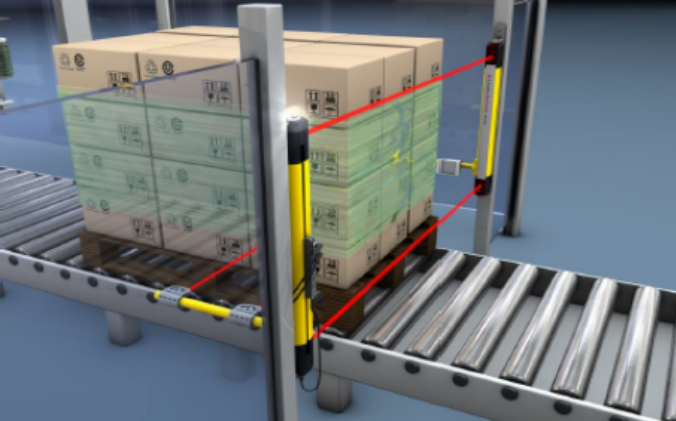
Hoists: Full‑perimeter safety fencing plus muting light curtains at access points to block unauthorized entry.
Stacker‑crane aisles: Two 270° safety laser scanners installed at both ends, dynamically adjusting protected zones according to travel speed.
Closing Remarks: Faced with the rigorous questions from the Jabil EHS manager, I confidently explained: “For every four‑way warehouse and production line we deliver, we do not merely attach safety labels to a small number of devices. Starting from risk assessment, we assign appropriate safety‑performance levels for each equipment type, covering full design, component selection and verification, with assessment reports delivered alongside hardware. Third‑party on‑site validation and corresponding evaluation reports are also available.” The Jabil project passed acceptance smoothly. The EHS manager confirmed FM Global was satisfied, as third‑party safety‑level reports existed for every moving unit.
Are your four‑way shuttles, stacker cranes, RGVs and hoists genuinely well‑protected?
My advice: do not only check whether safety hardware exists. Verify whether safety‑performance levels are sufficiently robust. Minor short‑term cost savings may lead to irreversible consequences once safety incidents occur.

Scan to add WeChat