
【Topic of This Issue】
Poor efficiency of cross‑floor material transfer in warehouses?
How to choose among lifts, AGVs and four‑way shuttles?
Technical Contributors: Shi Jian, Ding Liang
From extensive practice in overall‑plant logistics planning and design, we find that factory buildings are not always single‑floor large open spaces. Constrained by limited warehouse area and high land costs, utilizing vertical space becomes a natural solution. This is especially true for discrete‑manufacturing enterprises, whose factories often consist of multiple floors.
Although multi‑story factories reduce land cost per unit area, they bring new challenges for cross‑floor material transfer, and achieving seamless material conveyance is particularly difficult. Traditional practices require operators to move materials to elevator landings for queuing. During peak hours, goods pile up beside elevators, resulting in very low throughput.
With the development of automated warehouses featuring higher storage density and faster operating cycles, demands for cross‑floor transfer keep rising. How to realize economical, effective and stable cross‑floor handling and conveyance? We have summarized three cross‑floor solutions applicable to most factories for your reference.
Solution 1: Lifts — Mainstream Equipment for Cross‑floor Conveyance
Lifts are currently the dominant cross‑floor conveying equipment. Based on operating modes, they are mainly divided into reciprocating lifts and continuous lifts, delivering significant advantages over conventional freight elevators.
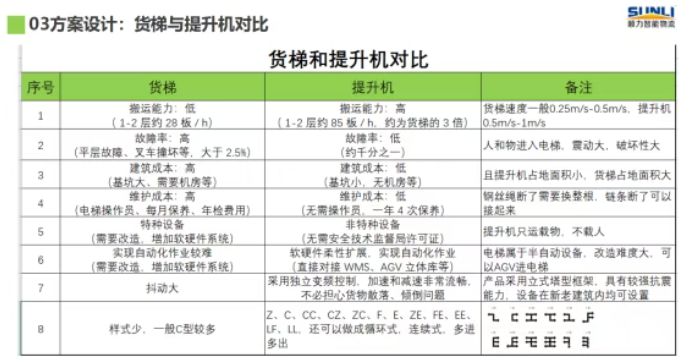
1. Reciprocating Lifts — High‑performance Option for Heavy‑duty Cross‑floor Handling
Widely deployed on‑site, reciprocating lifts excel at heavy‑duty cross‑floor transportation. Their working principle relies on a load‑carrying platform travelling up and down along guide rails inside a shaft, acting as an unmanned freight elevator.
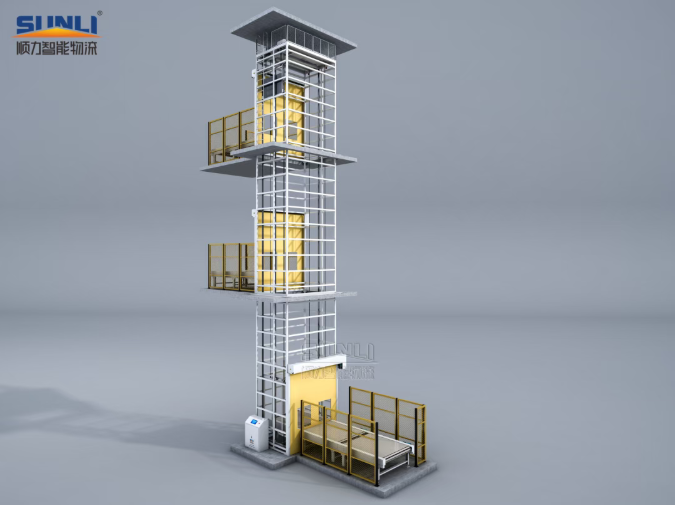
Rendering of reciprocating lift
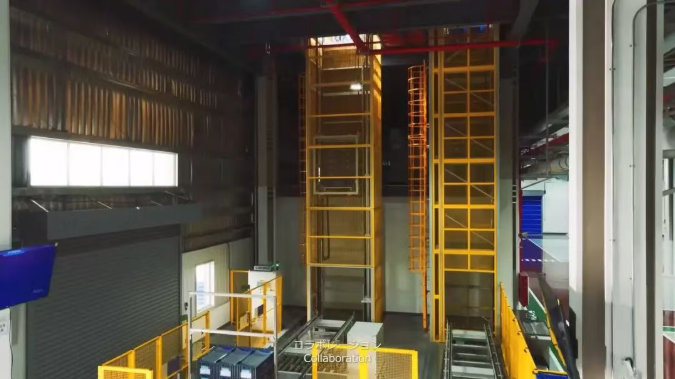
Reciprocating lift for Toyoda Gosei Project
Reciprocating lifts feature high load‑bearing capacity (from several hundred kilograms up to more than ten tons), flexible floor adaptability (stop at arbitrary floors), and high docking compatibility (seamless connection with various automated equipment). See the table below for common types. Proven by real‑world projects, one Sunly‑designed reciprocating lift can achieve a composite throughput of 62 pallets per hour between the 1st and 3rd floors, fully covering most medium‑volume scenarios.
Equipment Type | Inlet‑Outlet Layout | Typical Application & Features |
Classic Heavy‑duty Chain Lift | C‑type, E‑type, Z‑type | Pallet‑level, heavy‑load goods, multi‑floor stops; often used as main vertical trunk for high‑bay warehouses |
Side‑support Lift | Side in‑feed / out‑feed (variant of C/Z‑type) | For bins or pallets with side feeding; saves front‑end footprint |
Single‑mast High‑speed Lift | C‑type, Z‑type | Compact structure, fast lifting speed; for vertical conveying in space‑constrained workshops |
Fork‑type Chain Lift | C‑type, E‑type | Built‑in fork mechanism; directly interfaces with forklifts or AGVs for heavy‑duty pallets |
Special Lifting‑type Lift | Custom‑designed | Custom‑built for special workpieces (hanging goods, long profiles, etc.) |
Clamping‑type Lift | C‑type, Z‑type | Secures goods via clamping mechanism; for bags, cartons and irregular‑shaped items |
Sunly reciprocating lifts are equipped with multiple safety protections including anti‑falling, anti‑overtravel and chain‑breakage detection for reliable operation. Given its operating principle and heavy‑load characteristics, a single reciprocating lift can only handle one batch of goods at a time. Higher throughput can be achieved by adding extra lift units.
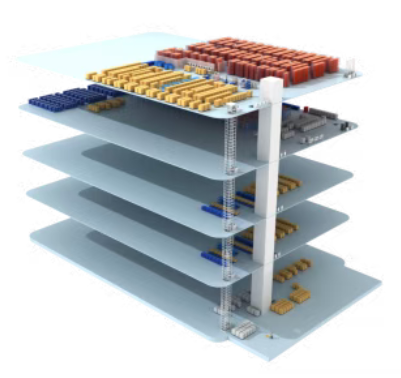
Schematic of Sunly lift passing through floors
2. Continuous Lifts — High‑throughput Star for Light‑load Applications
Unlike reciprocating lifts for intermittent heavy‑duty transport, continuous lifts adopt chains or belts to drive multiple load carriers in closed‑loop circulation for continuous upward and downward material flow, delivering light‑load and high‑efficiency performance.
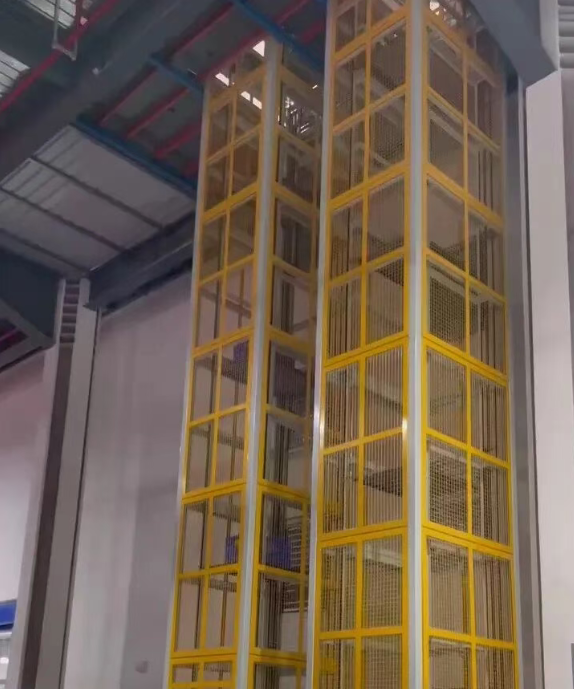
Sunly continuous lift
Continuous lifts feature high throughput (over 300 units per hour), compact footprint (less than 1.5 m²), and low energy consumption (20%‑40% energy‑saving vs conventional equipment). See the table below for common continuous‑lift types.
Equipment Type | Typical Application & Features |
Loop‑type Continuous Lift | Closed‑loop circulating carriers; suitable for high‑speed two‑point mass material transfer |
Continuous Vertical Lift | Non‑stop conveyance with extremely high capacity; for vertical sorting and transit of small‑sized light goods |
Bucket Elevator | Mainly for powder and granular bulk materials; widely used in food, feed and pharmaceutical industries |
Spiral Lift | Travels along spiral track; for steep‑angle routes or extremely space‑limited sites |
Inclined Lift Conveyor | Large‑angle belt / chain‑plate conveyor; low‑cost short‑distance floor‑to‑floor transition |
Flexible Lift Conveyor with Rear Baffles | Flexible baffles adapt to bins of varying heights; for e‑commerce and light‑industry flexible production lines |
Note the limitations of continuous lifts: their continuous‑flow design supports only two‑point transportation without multi‑floor stops. They are best suited for light‑weight, standard‑packaged small‑size carton‑based materials. Pallet handling is available upon customisation yet not generally recommended.
Solution 2: AGV + Smart Elevator — New Trend for Flexible & Intelligent Cross‑floor Transfer
Driven by flexibility and intelligence, the AGV‑plus‑smart‑elevator solution has become a popular emerging option. Unlike lifts requiring fixed rails or conveyor lines, AGVs connect with elevator control systems via dispatching software. They autonomously pick‑up goods, call elevators, enter cabins, select target floors, exit elevators and unload materials with zero manual intervention.
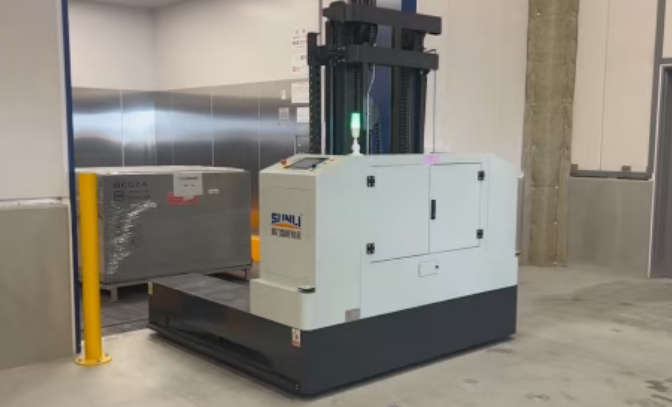
Sunly’s project in Japan
This AGV + smart elevator solution delivers three distinct advantages:
First, high flexibility. No fixed rails or conveyor infrastructure is needed; AGV routes can be simply updated when business workflows change.
Second, convenient retrofitting. Existing passenger or freight elevators in buildings can be reused without new elevator construction, making it ideal for warehouse renovation projects.
Third, enhanced safety. Built‑in collision‑avoidance functions make AGVs well‑suited for human‑robot mixed‑operation environments.
Nevertheless, drawbacks include high upfront AGV investment and throughput bottlenecks imposed by elevator performance. Comprehensive evaluation is required before adopting this solution.
Solution 3: Integrated Storage‑and‑Handling Warehouse Across Floors — Cross‑floor Four‑way Shuttle System
We have covered lifts and AGV‑smart‑elevator solutions, each with its own strengths. If your requirements go beyond simple cross‑floor material flow, and you expect seamless cross‑floor conveyance together with high‑density automated storage, Sunly’s cross‑floor four‑way shuttle dense‑storage solution (cross‑floor four‑way shuttle warehouse) is worth consideration.
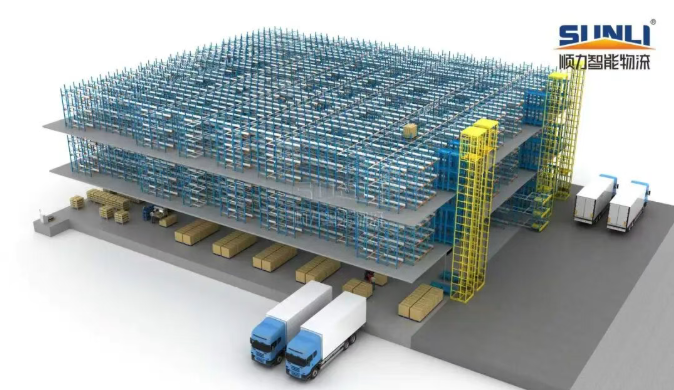
Sunly’s project for Guangdong Pharmaceutical Group Logistics Center
In a cross‑floor pallet four‑way‑shuttle warehouse, independent four‑way‑shuttle storage zones are deployed on each floor. Floors are interconnected by installing lifts through floor openings or by converting existing elevator shafts into lifts, forming one unified automated warehouse. Pallets travel horizontally on four‑way shuttles and switch floors via lifts, with fully unmanned operation.
Three key benefits of cross‑floor four‑way‑shuttle warehouses:
First, integrated storage and handling, combining warehousing and material movement within one system.
Second, flexible renovation. Lifts can be installed through new floor openings or retrofitted into existing elevator shafts; well‑suited for upgrading legacy factories.
Third, scalable throughput. Throughput can be scaled by adding or reducing four‑way shuttles and lifts, without hardware‑level bottlenecks typical of elevators.
This solution demands high‑quality upfront planning. Working with an experienced system integrator improves project reliability. Critical design points include floor‑opening positioning, lift selection and quantity calculation for four‑way shuttles. Although initial investment is higher than standalone lift solutions, it brings faster and greater return‑on‑investment.
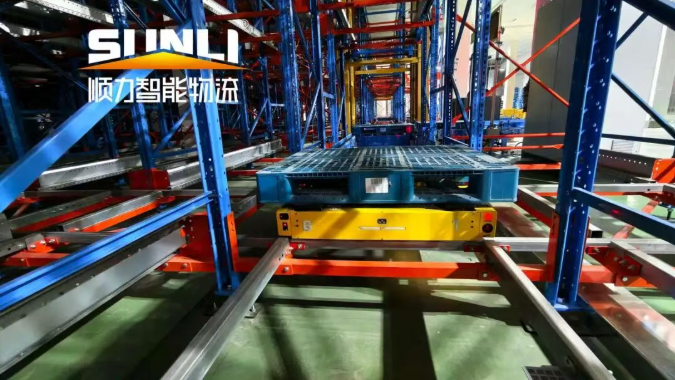
Sunly pallet four‑way shuttle
How to Select the Right Cross‑floor Warehouse Solution?
After learning about different solutions, many readers may still feel confused about how to choose properly without deep technical background. Below are simple evaluation criteria for your reference.
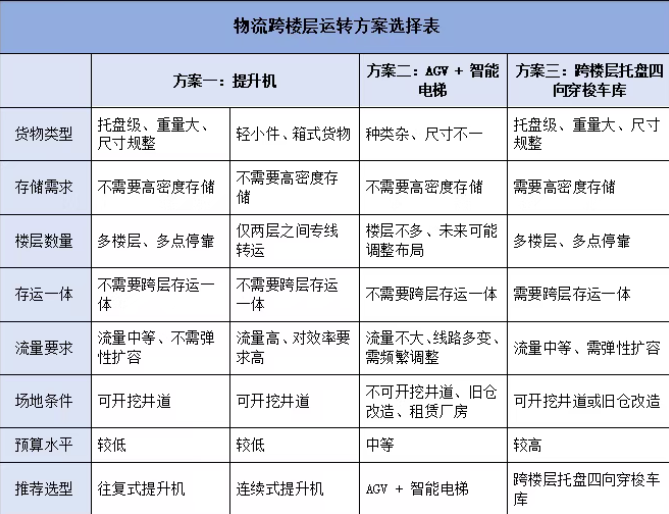
In short:
Choose reciprocating lifts for heavy‑weight materials requiring multi‑floor stops.
Choose continuous lifts for light‑weight materials with high‑volume throughput.
Choose AGV + smart elevator for high‑flexibility cross‑floor transfer and warehouse retrofitting scenarios.
If you require cross‑floor conveyance, multi‑floor stops, high‑density storage and one‑step warehouse automation, the four‑way‑shuttle warehouse paired with lifts represents the optimal balanced option.

Scan to add WeChat