
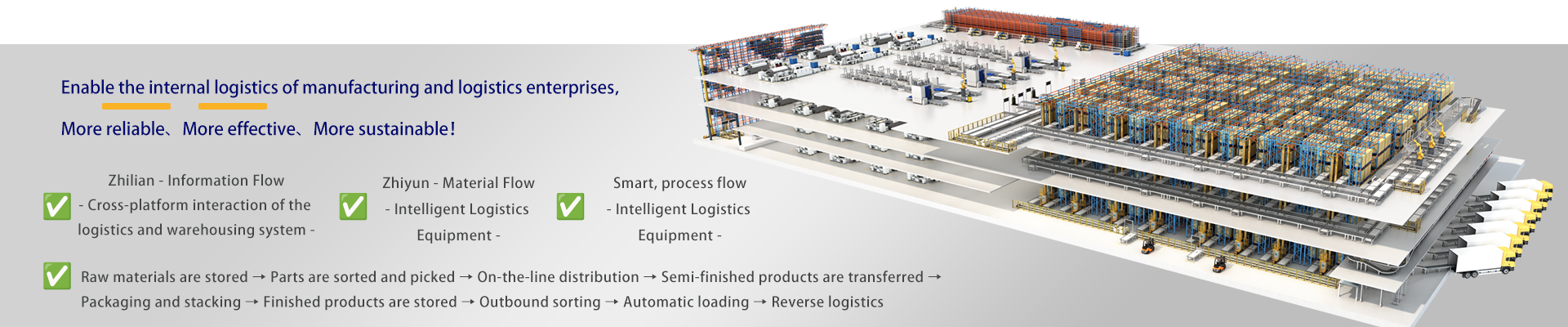

Warehousing racks constitute core hardware and digital‑intelligent carriers within modern logistics and warehousing systems. They can improve warehouse space utilization and optimize goods turnover efficiency. As indispensable supporting facilities for automated high‑bay warehouses, flexible warehousing and intelligent logistics hubs, they directly determine the load‑bearing capacity, operational efficiency and intelligence level of the entire warehousing system. With more than 50 years of development, China’s rack industry has achieved leap‑forward upgrading: from imitation to independent innovation, from low‑end processing to smart manufacturing, and from a purely domestic market to global‑oriented operations. At present, there are over 200 domestic rack‑manufacturing enterprises, and the annual output value of the whole industry exceeds RMB 20 billion. Widely applied in e‑commerce, new‑energy, manufacturing, pharmaceutical, cold‑chain and other sectors, it represents a core segment of the logistics‑equipment sector.
In 2025, the Technical Engineering Branch of China Warehousing and Distribution Association completed the first round of comprehensive industry‑wide research, filling the gap in authoritative industry statistics. In early 2026, the association launched the second‑round follow‑up survey. Adopting consistent statistical calibers and sample standards from 2022‑2024 and supplementing full‑year 2025 operational data, it has built a complete four‑year data‑observation system. Questionnaires were distributed to 180 mainstream domestic rack manufacturers, yielding 60 valid responses. Among them, 53 benchmark enterprises with complete scale indicators and detailed operational data were selected as core analysis samples, whose total output value accounts for over 80 % of the industry, rendering the data valuable for industry reference and business decision‑making. The statistical scope focuses on core warehousing‑rack business. Some enterprises also engage in other logistics‑equipment businesses, which may introduce minor deviations without distorting overall industry judgments. All operational data were self‑reported by enterprises without unified verification against financial statements. Going forward, the association will continuously optimize statistical standards, expand sample coverage and improve data accuracy.
I. Review of Core Operating Data of the Warehousing‑Rack Industry in 2025
(I) Overall Sales Volume Rises Steadily; Racks for Automated High‑bay Warehouses Become Major Growth Driver
From 2022 to 2025, total rack sales of sample enterprises followed a curve of “rapid growth — stable adjustment — moderate recovery”, with the proportion of sales for automated high‑bay‑warehouse racks keeping rising. In 2023, total industry sales rose by 11.94 % year‑on‑year, sustaining an upward market trend. In 2024, due to decelerated e‑commerce growth and shrinking fixed‑asset investment in manufacturing, total sales edged up merely 0.27 %, entering an adjustment phase. In 2025, concentrated demand release from new‑energy, intelligent manufacturing, cold‑chain warehousing and other sectors drove a 7.52 % year‑on‑year rebound in total industry sales, marking market stabilization and recovery. Calculated based on the 80 % industry share of the 53 sample enterprises, national total market demand for racks exceeded 2.57 million tons in 2025, up 20.69 % compared with 2022, reflecting continuous industry‑scale expansion.
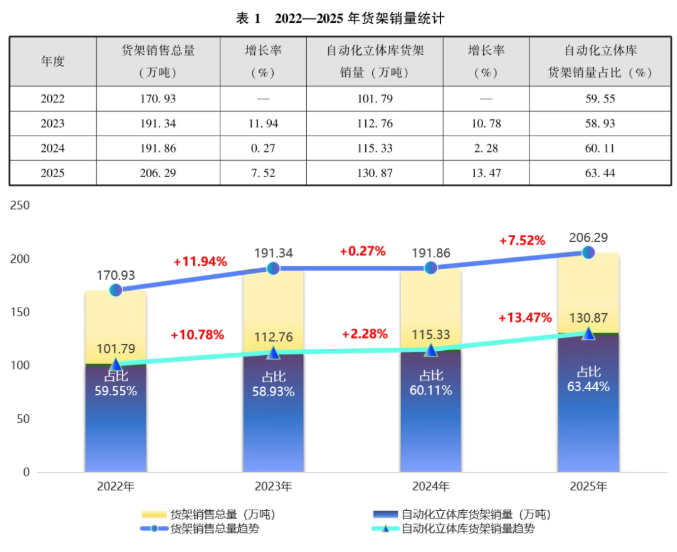
Product‑structure divergence is prominent: racks for automated high‑bay warehouses have maintained positive growth for years, accounting for 63.44 % of total sales volume in 2025 with growth rate far above the industry average and underpinning overall sales expansion. Market demand for conventional racks such as beam‑type and shelf‑type racks tends to be saturated with limited incremental space, dominated by stable market performance. This trend aligns well with the popularization of intelligent warehousing and digital‑transformation of factory storage facilities.
(II) Revenue Rebounds after a Downturn; High‑bay‑warehouse Racks Fuel Industry Revenue Recovery
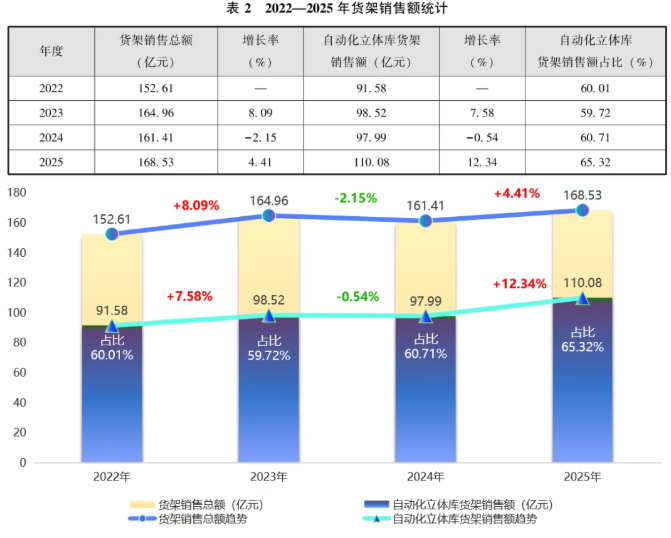
Total rack‑sales revenue of sample enterprises from 2022‑2025 experienced three phases: growth, decline and recovery, driven by fluctuating steel‑raw‑material prices and industry‑wide low‑price competition. In 2023, industry sales revenue increased by 8.09 % year‑on‑year, continuing the recovery momentum. In 2024, intensified internal competition and persistently falling steel prices pulled overall rack‑sales revenue down by 2.15 % year‑on‑year, the only negative revenue growth within the four‑year period. In 2025, rising share of intelligent rack products and surging overseas export orders pushed sales revenue up by 4.41 % year‑on‑year, achieving gradual industry revenue recovery. Among them, sales revenue of automated high‑bay‑warehouse racks grew by 12.34 % year‑on‑year, with its revenue proportion rising to 65.32 %, acting as the core driver for market upturn. Estimated from sample proportions, China’s overall rack‑sales scale reached approximately RMB 21 billion in 2025, steadily staying at the RMB 20‑billion level.
Persistent cost‑side pressure: steel accounts for 40‑50 % of rack production costs. Composite steel prices fell cumulatively by more than 35 % from 2020 to 2025, continuously squeezing product pricing margins. Coupled with year‑by‑year rising labor costs, overall industry gross profit margins keep declining, putting profit pressure on most manufacturers.
(III) Continued Decline in Average Market Prices; Intelligent High‑bay‑warehouse Racks Show Stronger Price Resilience
From 2022 to 2025, both the comprehensive ex‑factory average price of racks and the unit price of automated high‑bay‑warehouse racks trended downward, mainly due to falling raw‑material prices and homogeneous low‑price competition. The unit prices in this report cover ex‑factory, transportation, installation and commissioning. If only bare‑rack ex‑factory prices are counted, overall unit prices would drop by an additional 10‑15 %.
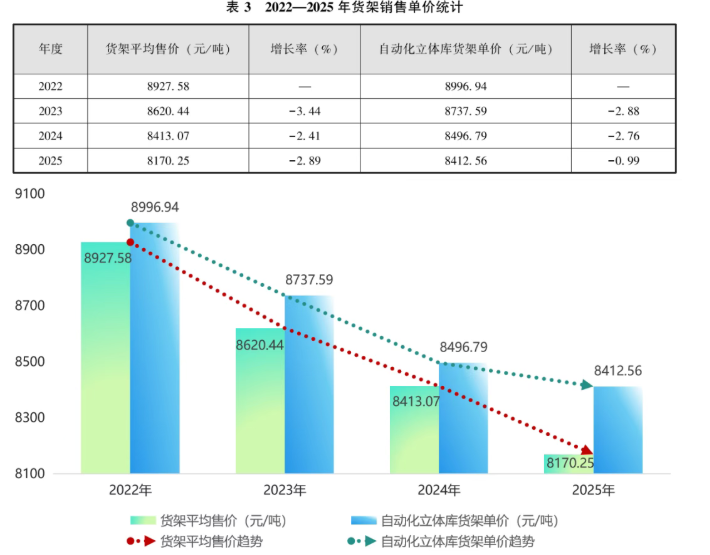
In 2025, the comprehensive average rack price decreased by 2.89 % year‑on‑year, with a larger drop compared with 2024. Although steel prices have reached a low level with limited further room for raw‑material price reduction, low‑end production capacity keeps expanding. Small‑and‑medium manufacturers seize market share via low pricing, while more players enter the mid‑tier market, triggering fierce homogeneous competition and dragging down average prices across product categories. By comparison, the unit price of automated high‑bay‑warehouse racks fell merely 0.99 % year‑on‑year in 2025, demonstrating markedly better price‑drop resistance than ordinary racks. This is because high‑bay‑warehouse racks impose stringent requirements on structural precision, mechanical load‑bearing and adaptability to automated equipment, with high barriers in production qualification and process technology, making large‑scale imitation difficult for small‑and‑medium manufacturers. Meanwhile, such racks are mostly delivered as part of complete intelligent‑warehousing projects. Downstream customers attach greater importance to product stability, delivery and after‑sales capacity, showing low sensitivity to standalone‑product prices and avoiding disordered price wars. In the long run, there is limited room for substantial price cuts for automated high‑bay‑warehouse racks. Enterprises must maintain profits and consolidate market advantages through structural optimization, standardized modules and large‑scale intelligent production.
(IV) Outstanding Resilience of Export Business; Overseas Markets Become a Stable Growth Driver
Amid fierce domestic‑market competition, overseas exports represent a stable growth track for the rack industry. Export revenue of sample enterprises recorded positive annual growth from 2022 to 2025, with a growing number of enterprises expanding overseas and broadening geographic coverage. Rack export volume surged 30.42 % year‑on‑year in 2023 as a bright spot for industry growth. Growth rates returned to reasonable ranges in 2024 and 2025, rising by 9.98 % and 11.85 % year‑on‑year respectively. Within four years, the proportion of enterprises engaged in overseas business climbed from 75.47 % to 94.34 %, and overseas‑market development has evolved from an optional choice into a consensus across the whole industry. Estimated from sample market shares, China’s total rack‑export value reached approximately RMB 6.4 billion in 2025, accounting for more than 30 % of total industry sales. Overseas markets have become an indispensable revenue source.
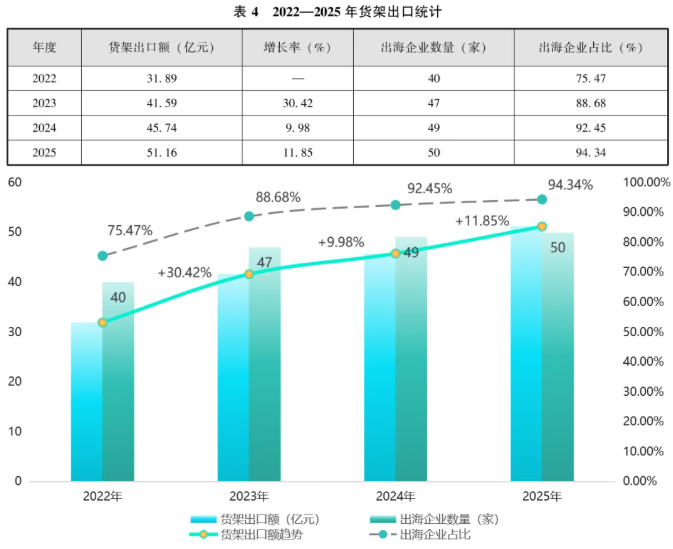
A diversified export‑region landscape has taken shape: Southeast Asia remains the top overseas market, with over 80 % of enterprises having established local presence in 2025. Japan‑South Korea and South America delivered remarkable growth: the share of enterprises covering Japan‑South Korea increased by 9.34 percentage points, and that for South America rose by 11.32 percentage points. Steady market penetration is observed in Europe, Africa, North America, the Middle East and other regions, forming a multi‑region balanced‑development pattern. Export products are also upgrading: early exports were dominated by simple conventional racks such as beam and shelf racks. In 2025, exports of racks for automated high‑bay warehouses and shuttle‑car systems exceeded 25 %. Domestic rack products are gradually shifting from low‑end OEM to mid‑to‑high‑end customized intelligent‑warehousing‑equipment exports. Enterprises adopt two major overseas‑expansion modes: direct foreign‑trade order acceptance, and cooperation via overseas system integrators and Belt‑and‑Road projects.
II. Five Core Development Characteristics of the Warehousing‑Rack Industry in 2025
(I) Growing Quantity‑Price Divergence: Overcapacity in Low‑end Segments versus Supply Shortage in High‑end Segments
A distinct industry feature emerged from 2022‑2025: steadily rising sales volume and modest revenue recovery accompanied by continuous decline in average product prices. The quantity‑up‑price‑down divergence intensified, alongside prominent product‑side structural differentiation. In 2025, industry sales volume rose 7.52 % and sales revenue increased 4.41 %, signaling clear demand‑side recovery. Nevertheless, continuous release of low‑end rack capacity and price competition among homogeneous products pushed the average‑price decline to 2.89 %, with industry price wars far from cooling down.
Striking structural pain points exist: the simple‑conventional‑rack segment suffers overcapacity with numerous small‑and‑medium manufacturers flooding the market and supply exceeding demand. By contrast, high‑precision intelligent racks compatible with shuttle cars, CTUs and high‑rise warehouses carry high technical barriers, with fewer than 10 enterprises boasting stable mass‑production capacity, resulting in product‑supply shortages. More than half of listed leading logistics‑equipment enterprises reported profit decline or even losses. Overall industry profit margin falls below 2 %. Warehousing‑system integrators face sustained profit pressure, further forcing rack manufacturers to compress margins. Stock‑market low‑price competition will persist for a long time.
(II) Internal Structural Iteration of Automated High‑bay Warehouses: Box‑type High‑bay‑warehouse Growth Outpaces Pallet‑based Warehouses
After racks for automated high‑bay warehouses accounted for over 60 % of the total market, obvious internal product‑structure changes have occurred. Racks for box‑type high‑bay warehouses have outgrown traditional pallet high‑bay warehouses for two consecutive years and become a core growth track. Explosive demand for small‑batch, multi‑batch, high‑turnover storage in e‑commerce, pharmaceutical, 3C‑electronics and new‑retail industries has driven surging orders for Miniload box‑type high‑bay warehouses, shuttle‑car goods‑to‑person systems and robot‑compatible racks. Meanwhile, far higher standards are imposed on rack‑processing precision, rail flatness and overall structural stability compared with traditional pallet warehouses.
Racks for automated high‑bay warehouses are developing toward multi‑form configurations, flexible adaptability and high precision. High‑bay warehouses equipped with shuttle cars and AGVs are gradually replacing traditional stacker‑crane‑based high‑bay warehouses and becoming mainstream flexible‑warehousing solutions. Full‑automatic rolling mills and high‑precision welding equipment are widely deployed. Industry competition criteria have evolved from “ability to produce racks” to “ability to adapt to complete intelligent‑warehousing systems”.
(III) Large‑scale Application of New Materials: High‑strength Steel and Galvanized Sheets Become Mainstream Material Choices
Breaking away from the single‑material mode relying on ordinary Q235 steel, cost reduction and efficiency improvement via material upgrading has become a common industry approach. High‑strength steel and hot‑dip galvanized sheets have achieved large‑scale application. Compared with conventional steel, high‑strength steel delivers over 30 % higher strength, 20 % less steel consumption, 50 % better anti‑corrosion performance and extends equipment service life by 5‑8 years. Galvanized‑sheet racks eliminate highly polluting processes such as pickling and spraying, shortening production cycles by 30 % and cutting manual‑processing costs by 20 %. Their penetration rises rapidly in cold‑storage, food‑processing and pharmaceutical‑clean‑warehousing scenarios. Material innovation serves both as a cost‑control measure for enterprises and a core competitive advantage for market entry and international foreign‑trade competition.
(IV) Accelerated Global Layout; Two Distinct Overseas‑expansion Routes for Enterprises
Two clear overseas‑expansion paths have emerged for domestic enterprises. Some enterprises focus on overseas standardized‑rack markets and capture mid‑to‑low‑end overseas markets leveraging cost advantages. Other leading enterprises operate both domestic and overseas businesses, focusing on exports of automated high‑bay‑warehouse racks while planning overseas production bases to circumvent trade barriers of various countries. Nevertheless, overseas‑oriented enterprises generally face multiple thresholds: strict overseas intellectual‑property protection, CE and other environmental‑certification requirements, and divergent local installation‑and‑operation‑maintenance specifications. Compliance is a compulsory course for all foreign‑trade enterprises.
(V) Three‑tier Competition Pattern Takes Shape; Industry Accelerates Survival‑of‑the‑Fittest
Market concentration keeps rising, ending chaotic competition and forming a clear multi‑tier landscape. Top‑tier players (top‑10 enterprises): combined market share exceeds 61 %, with full‑chain capabilities covering R&D, solution design, large‑scale production, on‑site installation and warehousing‑system integration. They focus on automated high‑bay warehouses, overseas trade and large‑scale intelligent‑warehousing turnkey projects. Mid‑tier enterprises: mass‑produce standardized conventional racks, focus on domestic mid‑tier markets and supply regional manufacturing and logistics enterprises. Small‑and‑micro bottom‑tier enterprises: concentrate on local small‑sized simple‑rack supply and pursue niche specialized tracks. There are roughly 200 above‑scale rack‑manufacturing enterprises nationwide, yet only 47 of them achieve annual revenue above RMB 50 million. In the next three years, small‑and‑medium manufacturers lacking technical‑and‑scale advantages are expected to face an annual elimination rate of 10‑15 %, as the industry evolves toward a mature concentrated market.
III. Five Medium‑and‑Long‑term Development Trends for the Warehousing‑Rack Industry
(I) Business‑model Transformation: From Standalone‑rack Sales to Integrated Intelligent‑warehousing Solutions
Fundamental shifts are taking place in industry business logic. Pure sales of steel‑structure racks are gradually replaced by complete intelligent‑warehousing turnkey services, with racks functioning merely as core components of intelligent warehousing systems. Leading enterprises go beyond rack manufacturing and sales. They integrate stacker cranes, shuttle cars, AGVs and WMS/WCS warehousing‑management systems to deliver end‑to‑end services covering “pre‑project solution planning — customized rack production — automation‑equipment integration — on‑site installation and commissioning — post‑delivery operation and maintenance”. Value‑added of complete solution‑based products increases by over 30 %.
In the future, core enterprise competitiveness will shift from manufacturing capability to warehousing‑solution design and multi‑system integration capacity. Finite‑element structural simulation, digital‑twin simulation and intelligent‑equipment‑interconnection technologies will become standard corporate capabilities. Market space for pure OEM‑oriented manufacturers will keep shrinking.
(II) Production‑model Innovation: Large‑scale Production and Standardization as Core Countermeasures against Long‑term Price Wars
Low‑price competition will persist long‑term. The key for enterprises to break through lies in mass production and modular standardized customization. Rack costs are concentrated in production‑processing, long‑distance transportation and on‑site installation. Standardized and modular product design unlocks mass‑production potential, greatly reducing losses in design, processing and labor, lifting production efficiency by 3‑5‑fold. Automated production‑line transformation is critical for cost reduction: intelligent full‑process transformation for automatic rolling, cutting, welding and packaging lowers labor dependence and unifies product quality. Meanwhile, optimized structural design cuts steel consumption, controlling overall costs under guaranteed load‑bearing performance to offset pressure from low‑price competition.
(III) Reshaped Market Landscape: Overseas Markets Serve as Core Increment; Compliance and Localization Determine Competitiveness
Intensified stock‑market competition in China renders overseas markets the new industry growth curve. Spill‑over of domestic manufacturing capacity constitutes a long‑term trend. Foreign‑trade orders will evolve from supplementary increments into core revenue sources. The industry export‑value annual growth rate is projected to stay at 5‑8 % during 2026‑2028, with long‑term export‑sales proportion expected to reach 50 %.
Overseas‑oriented enterprises need to overcome three major bottlenecks: high risks of overseas‑patent‑infringement, making intellectual‑property‑right layout essential; high environmental‑protection and certification thresholds in European‑American markets, where compliant qualifications represent market‑entry prerequisites; imperfect local overseas installation‑and‑after‑sales‑service systems restraining sustained market expansion. Clear differentiation will emerge among overseas‑oriented enterprises: well‑funded, technologically‑sound and fully‑qualified leading enterprises will deepen overseas‑market presence and build overseas production bases. Small‑and‑medium manufacturers will target emerging markets such as Southeast Asia and the Middle East, supplying standardized economical‑rack products. Differences in compliance capacity and local‑service quality will widen gaps among foreign‑trade players.
(IV) Product‑technology Iteration: Three R&D Directions — Scenario‑specific Customization, Green Low‑carbon Development and Lightweight Design
① Scenario‑specific customization: Demand for special‑purpose racks for lithium‑battery storage, cold‑chain warehouses, pharmaceutical clean‑rooms, food‑processing plants and other segments keeps rising. Customized functions including anti‑static, low‑temperature‑resistant, anti‑corrosion and heavy‑load‑bearing performance become basic requirements;
② Green low‑carbon manufacturing: Traditional pickling‑and‑spraying processes are gradually phased out. Galvanized non‑spray materials gain wide adoption, and recyclable‑steel utilization rates keep improving. This complies with China’s dual‑carbon goals and meets overseas environmental‑access standards;
③ Lightweight structural design: High‑strength steel replaces ordinary steel combined with mechanical‑structure optimization, reducing rack self‑weight while satisfying load‑bearing standards and lowering comprehensive costs for transportation and on‑site installation.
(V) Upgraded Profit‑making Model: Shifting from Product Margins to Full‑life‑cycle‑service‑driven Profitability
Industry profit‑making logic is shifting from earning hardware‑product price differences to comprehensive full‑life‑cycle warehousing services. The proportion of service‑related revenue has risen from the original 5 % to 15‑20 %. Expandable services include pre‑project solution design, on‑site installation and commissioning, annual equipment operation‑and‑maintenance, warehousing‑system upgrading, and recycling‑and‑retrofitting of legacy racks. Leading enterprises innovate new service modes such as rack leasing, warehousing trusteeship and intelligent‑warehousing outsourcing to escape low‑price internal competition and greatly enhance profit stability.
Conclusion
Overall, the warehousing‑rack industry is steadily iterating along automation, digitalization, intelligence and green‑development trajectories. Clear paths for industry breakthrough have been identified: escape homogeneous low‑price competition via technological innovation, cut comprehensive costs through standardized large‑scale production, unlock incremental markets via global foreign‑trade business, and lift overall competitiveness with green manufacturing and full‑life‑cycle services. Going forward, the Technical Engineering Branch of China Warehousing and Distribution Association will keep improving the industry statistical system, build enterprise‑exchange platforms, promote standardized, high‑quality and sustainable industry development, and underpin the construction of domestic modern‑logistics infrastructure.

Scan to add WeChat