
Topic for This Issue
How much to replenish,when to replenish,priority handling for urgent tasks,and peak-shifting arrangements—all explained clearly
Technical Lead for This Issue:Liu Qianyun
Many warehouses follow a simple replenishment rule:generate a replenishment task when the inventory at the pick face drops below a set threshold.This rule may sound reasonable,yet the flaw lies in the trigger itself.By the time the system fires the replenishment alert,the pick face is nearly empty.The replenishment operator is still working in another zone,while the order picker has already arrived at the location.
Replenishment Trigger Point:Calculated Scientifically,Not Decided by Experience
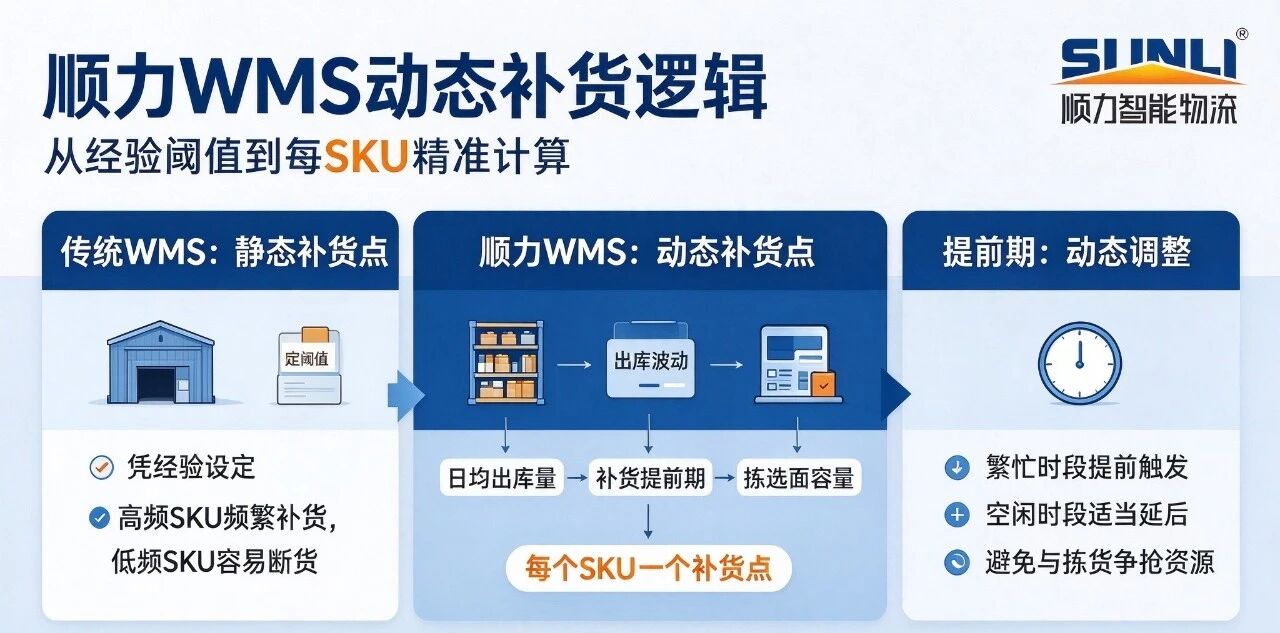
The first question is timing:when should replenishment start?
In most WMS platforms,the replenishment trigger point is a static value.For example,trigger replenishment when fewer than 10 units remain on the pick face.This figure is usually set empirically or estimated subjectively during system deployment.The outcome is predictable:fast-moving SKUs trigger replenishment repeatedly and consume most of the replenishment team’s capacity,while slow-moving SKUs may go months without restocking.When an order for a slow-moving SKU finally comes in,the pick face is often out of stock.
Sunli WMS calculates dynamic replenishment trigger points.For each individual SKU,the system runs calculations based on historical daily outbound volume,outbound fluctuation,replenishment lead time(the interval between triggering replenishment and finished putaway),and pick face capacity.
Example:An SKU ships 12 units per day on average,with a 2-hour replenishment lead time.Theoretically,replenishment should start when only 3 units are left on the pick face to avoid stockouts.If outbound volume fluctuates sharply—say 2 units on some days and 30 on others—extra buffer stock will be allocated.The system factors in all these variables and assigns a unique trigger point to every SKU,instead of applying one uniform value across the warehouse.
One easily overlooked detail:replenishment lead time is not fixed.During busy morning shifts,lead time may stretch to 3 hours;at night with minimal picking activity,it can drop to half an hour.Sunli WMS adjusts lead time dynamically according to current workload.Replenishment is triggered earlier in peak hours and deferred during slack periods,preventing competition for resources between replenishment and picking.
Replenishment Quantity:Derived from Capacity and Forecasted Consumption
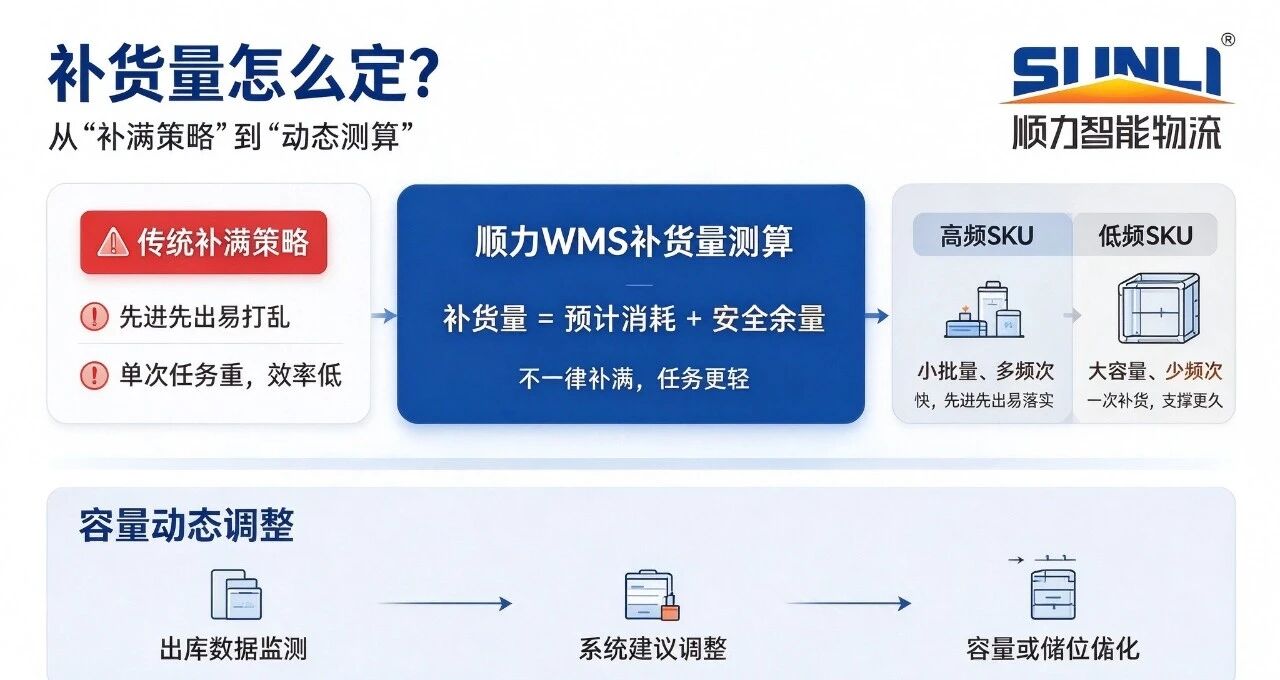
The second core question is quantity:how much to add each time.
Many warehouses adopt a fill-to-max strategy,refilling the pick face to full capacity whenever replenishing.This approach seems convenient but carries two drawbacks.First,overstocked pick faces make lot rotation difficult,and newly added goods may stay trapped at the bottom for long periods.Second,each replenishment task becomes heavy.Operators often handle only one SKU per trip,dragging down productivity.
Sunli WMS calculates replenishment quantity based on pick face capacity and forecasted consumption.The system estimates consumption over the upcoming period and restocks to cover that demand plus a safety buffer,rather than filling the location completely.Individual tasks become lighter,multiple SKUs can be grouped into one replenishment route,and operators can service multiple rack locations in a single pass.
Fast-moving SKUs follow a small-batch,frequent replenishment pattern.Their pick face capacity is set smaller,replenishment frequency rises,and per-batch quantity falls.Goods on the pick face maintain good turnover,lot rotation is easier to enforce,and pickers do not need to dig through stacked inventory.Slow-moving SKUs work the opposite way:larger pick face capacity supports longer intervals between restocks.
Pick face capacity is not locked during warehouse setup.The WMS keeps suggesting adjustments using real outbound data.If an SKU sees a sudden sales spike,the system recommends expanding its pick face or relocating it to a larger storage location.
Pre-replenishment:Stock Ready Before the Picker Arrives
The rules above cover timing and quantity,but pre-replenishment creates the real performance gap between systems.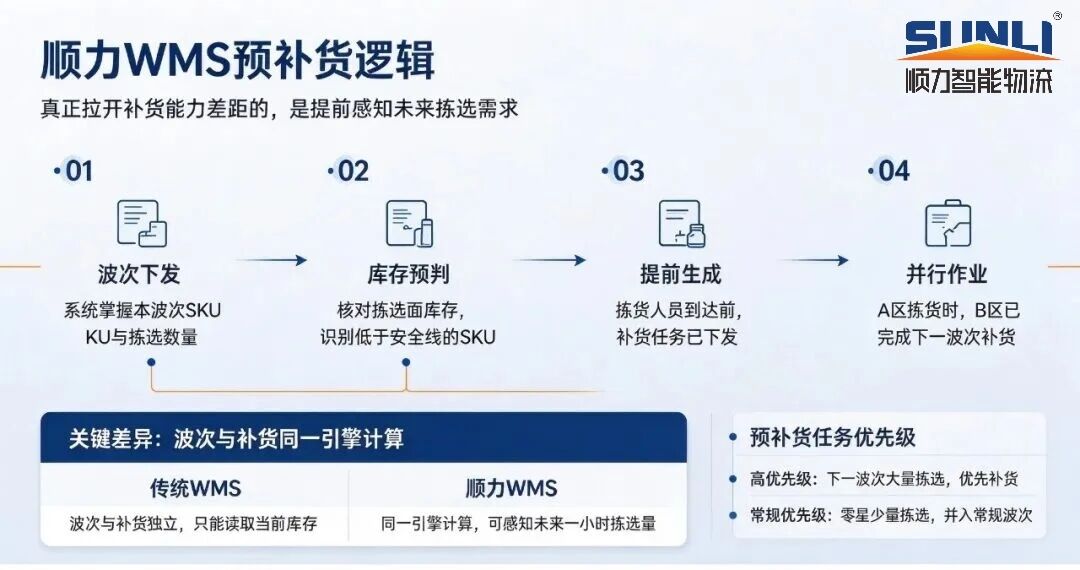
When the WMS releases a picking wave,it already knows which SKUs are required and the picking quantity for each.It cross-references this requirement against current pick face inventory.If inventory after this wave will fall below the safe threshold,a replenishment task is generated before the picker reaches the location.
In practice:while pickers work in Zone A,replenishment operators are already restocking Zone B for the next picking wave.By the time pickers arrive at Zone B,inventory is ready,and they may not even notice that replenishment has taken place.
This capability relies on wave-replenishment linkage.Traditional WMS keeps wave management and replenishment separate.Replenishment only reads live inventory and cannot anticipate future picking demand.Sunli WMS runs wave allocation and inventory assignment on the same calculation engine,so replenishment can access forecasted withdrawal volumes for the coming hour and arrange restocks in advance.
Pre-replenishment tasks also carry priority tiers.SKUs scheduled for large picking volumes in the next wave are marked high-priority and processed first.Minor sporadic demand can merge into regular replenishment waves without separate trips.
Urgent Replenishment:Allowed to Jump the Queue Without Disrupting Regular Workflows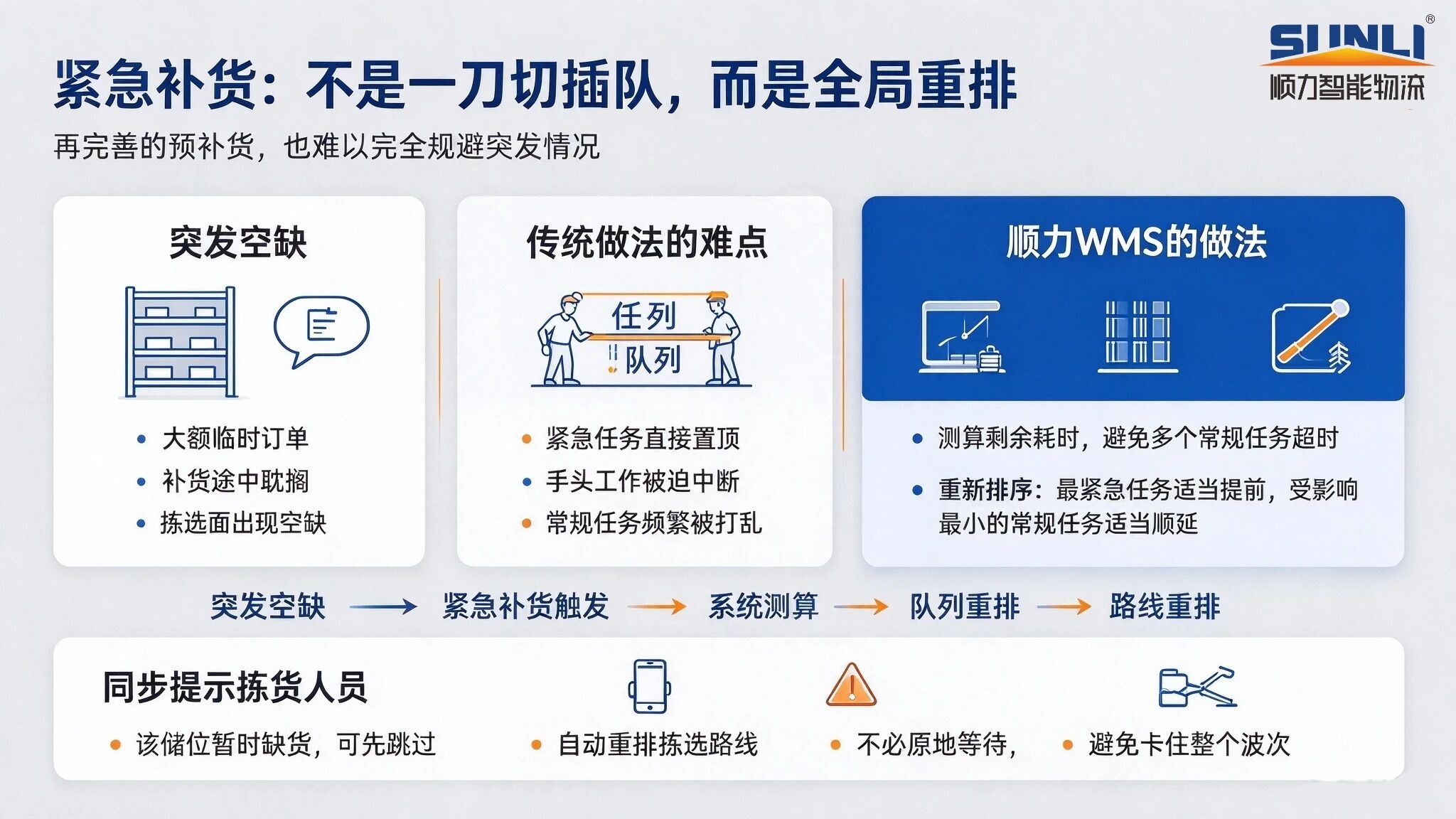
Even robust pre-replenishment cannot eliminate surprises.A sudden large order for one SKU,or delays mid-replenishment,may leave a pick face empty and trigger urgent replenishment.
The main challenge with urgent replenishment is queue prioritization.The conventional method pushes urgent tasks straight to the front of the queue.Operators must pause ongoing work.This works occasionally,but frequent interruptions break the steady rhythm of routine replenishment.
Sunli WMS sets limits on queue jumping.The system calculates the remaining workload for the assigned replenishment operator.If inserting the urgent task would cause multiple regular tasks to miss deadlines,it does not blindly give urgent requests full priority.Instead,it resequences the whole queue:moving critical tasks forward moderately while deferring the least impacted regular tasks.It avoids a one-size-fits-all rule that halts all routine work.
When urgent replenishment activates,the system also alerts pickers about the temporary stockout.If their task includes this SKU,they can skip it,proceed with other picks,and return later after restocking.Picking routes recalculate automatically.This small feature protects picking flow;one missing SKU no longer stalls an entire wave.
Conflicts Between Replenishment and Picking:A Hidden Productivity Drain
Narrow-aisle congestion is common at peak times:a replenishment forklift occupies the aisle for putaway,and order pickers with picking carts have to wait or reroute.Most WMS cannot coordinate this because replenishment and picking tasks are issued by independent modules.
Sunli WMS connects deeply with WCS/RCS to track the real-time positions of personnel and equipment.Replenishment tasks are scheduled to avoid hot picking zones.For instance,if the system forecasts heavy picking activity in Zone A over the next 20 minutes,it postpones Zone A replenishment and prioritizes Zones B and C.Once the picking wave in Zone A finishes,the system schedules concentrated restocking there.
This is peak-shifting replenishment.Picking and replenishment workflows stagger,aisle congestion eases,and both teams gain efficiency.The logic itself is straightforward.The hard part is that the system must maintain visibility over both picking and replenishment plans plus live location data for on-site resources.Replenishment cannot be managed in isolation.It must sit within the unified scheduling framework of the whole warehouse.

Scan to add WeChat